
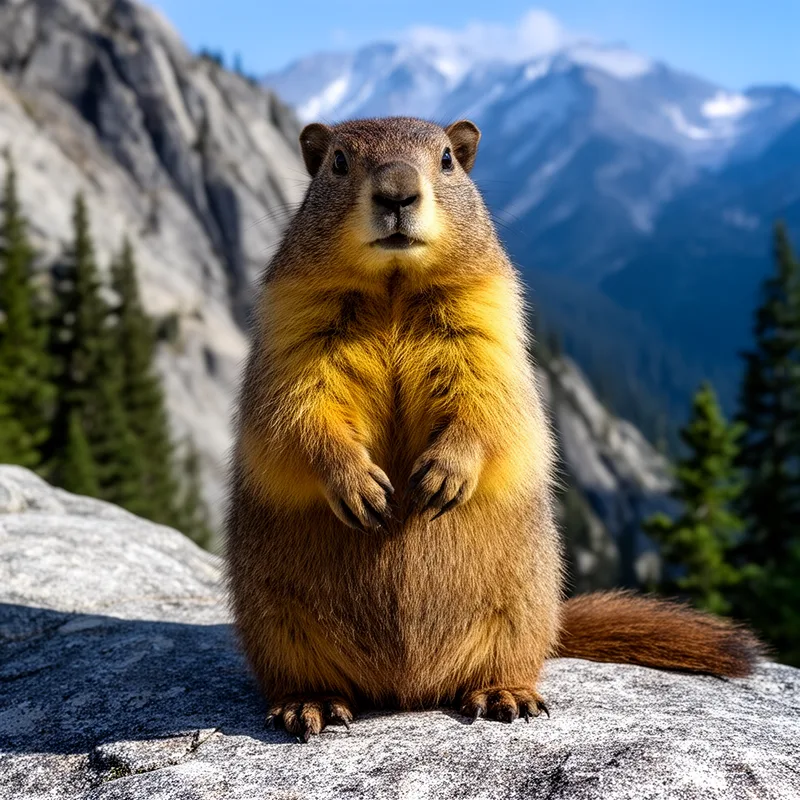
yellowbelly marmot
- noun
- /ˈjɛloʊˌbɛli ˈmɑrmət/
- US
- The yellowbelly marmot is often seen basking on rocks in the mountainous regions of Colorado.
Examples
-
Researchers tracked the movements of several yellowbelly marmots to study their hibernation patterns.
-
Predators like coyotes and eagles frequently prey on the yellowbelly marmot in the wild.
-
The yellowbelly marmot is known for its distinctive coloration.
-
Have you ever seen a yellowbelly marmot in the wild?
-
The yellowbelly marmot is a common sight in the rocky habitats of the Rocky Mountains.
-
During the summer, yellowbelly marmots can be observed foraging for food in grassy areas.
-
A group of yellowbelly marmots often gathers near their burrows to sunbathe.
Synonyms

 8
7.2
8
7.2

A large animal like a big squirrel that lives in holes in mountains and sleeps all winter
A large yellow-bellied rodent that lives on rocks in western North America
A large brown animal like a big squirrel that lives in rocky places
Surface Forms
Morphology
yellowbelly + marmot
The compound is compositionally transparent: 'yellowbelly' is interpretable as yellow + belly (a yellow-bellied animal) and 'marmot' names a rodent, so a learner who knows those constituents can infer a marmot with yellowish coloration. Although 'yellow-bellied' can be idiomatic for 'cowardly' in other contexts, in this animal name the meaning is literal and directly derivable from the parts.
Etymology
Yellowbelly marmot comes from how the animal looks: it often has a yellowish underside, so people described its yellow belly. The second word 'marmot' names the animal, so the whole name simply tells you it is a 'marmot' with a yellow belly.