
yellow fever
 9
3.7
9
3.7

- noun
- /ˈjɛloʊ ˈfiːvər/
- Specialized
- Due to Hood's untimely death from yellow fever in 1879, Johnston refrained from contradicting his foe's posthumous countercharges.
- yellow fever epidemic
- yellow fever mosquitoes
- yellow fever vaccine
Loading YouTube…
Watch on YouTubeAnd then from Africa, yellow fever and and malaria come in.
- And then from Africa, yellow fever and and malaria come in.
- These were the first one was yellow fever vaccine that was made because that was a big problem.
Examples
-
Of these, dengue and encephalitis are major health threats, and yellow fever still takes a severe human toll in Africa.
Academic text (1992) -
At the height of their effort, 500 workers... ... were dying every week from malaria and yellow fever.
-
You could still contract yellow fever.
-
Between September 8 and September 21, his wife, mother, and brother all died of yellow fever.
Academic text (2004) -
His wife, Eleanor, died of yellow fever.
-
Ideally, pregnant women should avoid yellow fever risk areas.
Academic text (2011) -
During World War II, the French conducted an enormous campaign against yellow fever, vaccinating 11 million Africans.
Academic text (1993) -
Mosquitoes were abundant and often carried yellow fever and other deadly diseases.
Fiction book (1996) -
In Cuba, troops had widespread and debilitating fevers from typhoid, malaria, and yellow fever, among other illnesses.
Academic text (2012) -
Many travelers get vaccinated against yellow fever before visiting tropical regions.
Synonyms

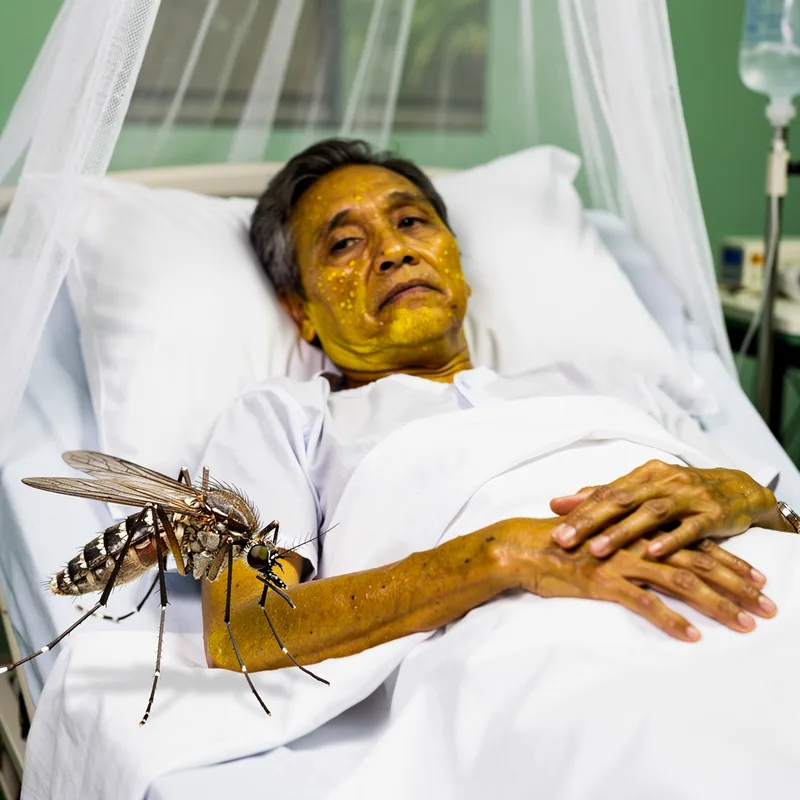
A serious disease spread by mosquitoes that causes fever and yellow skin
Surface Forms
Morphology
The compound directly combines 'yellow' (indicating jaundice/yellowing of the skin) and 'fever' (an elevated body temperature), so a learner who knows both words can infer a fever associated with yellowing and thus a specific illness. The construction is transparent and mirrored in many languages (e.g. Spanish 'fiebre amarilla'), making the disease meaning predictable to B1 learners.
Etymology
Yellow fever gets its name from the two clear signs doctors saw: a high fever and skin that turned yellow. So, the phrase now means a serious 'disease' that causes fever and yellow skin.