
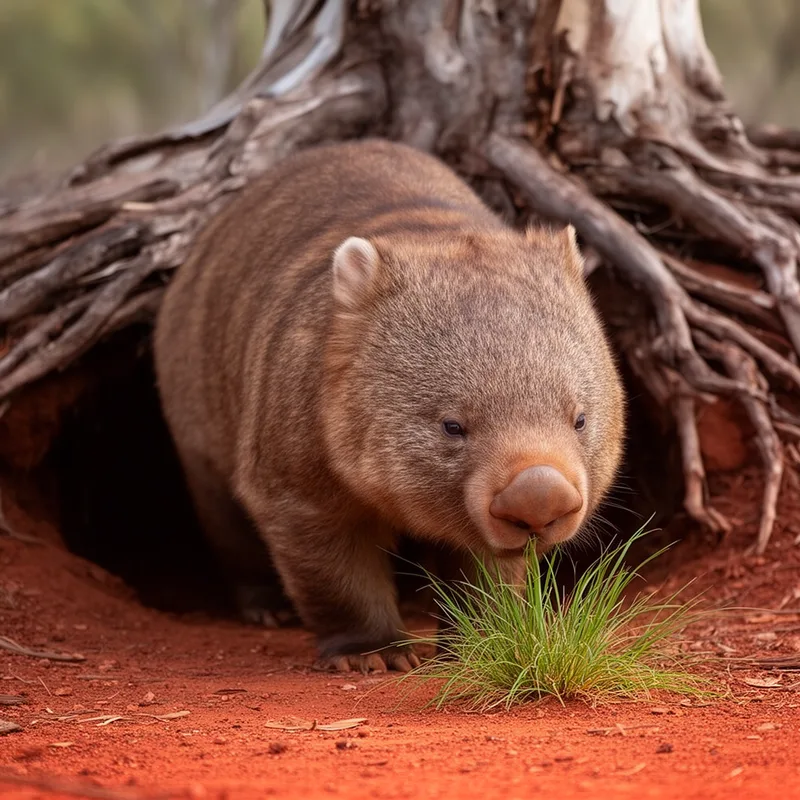
wombat
 8
5.1

- noun
- /ˈwɑːm.bæt/
- Australian
- The brown wombat was covered in dirt, and his muzzle was scratched and grimy.
- the hairy-nosed wombat
- the common wombat
- a wombat's burrow
Loading YouTube…
Watch on YouTubeWhat is the shape of a wombat's poo?
- What is the shape of a wombat's poo?
- And I think I have what it takes to be a sexy wombat.
- Everything else is something, you know, an alien, a wombat, an Otter, a ghost, a worm, a duck.
- You guys are like a, like a like a like when the, you know, when the, the, the rare white wombat comes to the zoo or whatever.
Examples
-
With the gradual drying of the Australian climate during the Pleistocene, wombats evolved into burrowers.
Academic text (1995) -
We set the wombats up in enclosures in order to monitor their food intake.
Academic text (1995) -
The little gray wombat looked him in the face, worry in his vague blue eyes.
Fiction book (1992) -
The greatest threat to wombats, as with most other species, is humans.
Academic text (1995) -
Will you continue his research on wombat mating habits?
-
The national zoological institute has asked us to study the Australian wombat.
-
Did you know wombats poop squares?
-
In the remaining pastures, wombats must compete for food with introduced herbivores such as rabbits and sheep.
Academic text (1995) -
Equipped with stubby legs and broad feet with claws, wombats can excavate several feet of tunnel per night.
Academic text (1995) -
The national zoological institute has asked us to study the Australian wombat.
Surface Forms
Etymology
Wombat comes from an Australian Aboriginal word, probably wambad from the Dharug language of the Sydney area. That original name simply named the animal, which is why wombat today means the burrowing, short-legged mammal that carries its young in a pouch.