
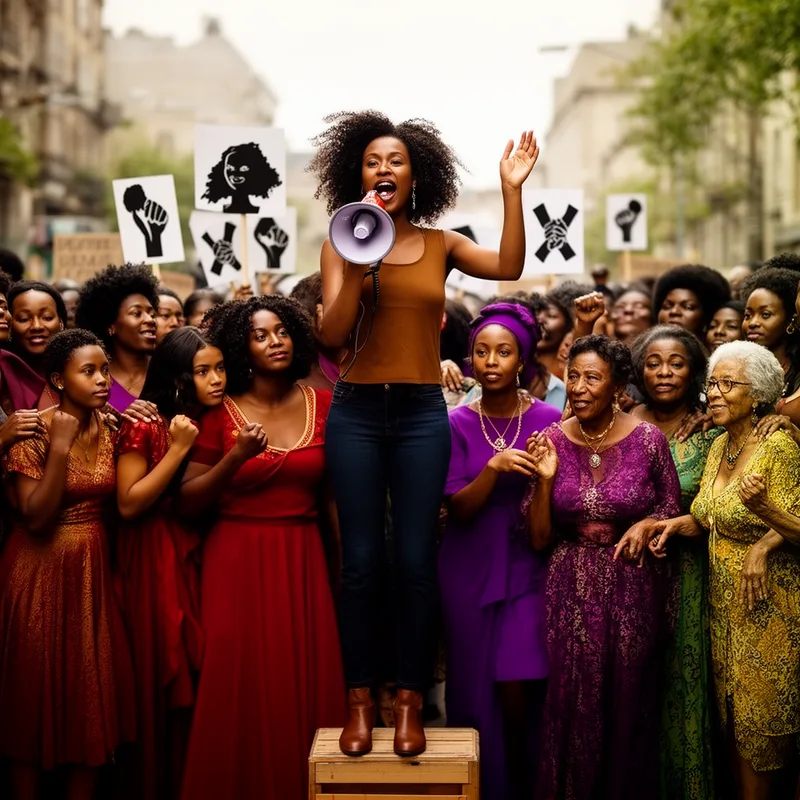
womanism


 1
8.4
- noun
- /ˈwʊmənɪzəm/
- Formal
- Many scholars argue that womanism plays a crucial role in understanding the complexities of race, gender, and culture for African American women.
Examples
-
Hine believed that womanism speaks to a double legacy of oppression and a resistance movement among African American women.
Academic text (1997) -
The Prayer Band's concern for the "survival and wholeness of an entire people" led me to embrace womanism as a seminarian.
Academic text (1998) -
To deal with the problem of terminology, author Alice Walker (1983) and others (Hine, 1996; Ogunyemi, 1985) have used the words "womanist" and "womanism" to describe the African American female experience.
Academic text (1997) -
Alice Walker introduced the term womanism to emphasize the unique experiences of Black women in society.
-
The concept of womanism highlights both the rights and perspectives that are often overlooked by traditional feminism.
Surface Forms
Morphology
Etymology
Womanism was coined by Black writer Alice Walker from woman and the ending -ism ('a belief or movement'). It names a movement and way of thinking that puts the experiences, rights, and voices of Black women at the center.