

winter melon
- noun
- /ˈwɪntər ˈmɛlən/
- The chef prepared a delicious soup using fresh winter melon and spices.
Examples
-
In many Asian dishes, winter melon is prized for its mild flavor and texture.
-
PHOTO (BLACK & WHITE): The waiter at the luxury hotel in Canton dishes soup from a giant winter melon.
Academic text (1995) -
Is it winter melon or squash?
Fiction book (2002) -
Sweetened by rock sugar and dried longan, it also comes with winter melon and a cheap price tag.
Blog text (17) -
So we cooked that down here and then we end up with this kind of cold, almost puree sauce of winter melon that it still has some texture.
-
At the market, I bought a large winter melon to use in my stir-fry recipe.
Synonyms

 86
1.0
86
1.0

A large round or oval fruit with thick skin and soft sweet inside like a watermelon
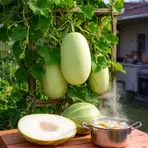
A climbing plant that grows large smooth fruits used in Asian cooking

A group of melons with smooth white skin and pale flesh that have little or no strong musky smell
Surface Forms
Morphology
The compound is transparently built from 'winter' + 'melon', so a learner who knows both words can infer it denotes a type of melon associated with winter (a particular fruit/plant). Although botanical or culinary specifics (e.g. that it is the wax gourd used in Asian cooking and not a sweet melon) may be unknown, the basic referent as a seasonal fruit/plant is compositionally predictable.
Etymology
Winter melon got its name from how people stored the large green fruit so it would last into 'winter'. People would cover it with wax or dry it and keep it for months, so the melon was still ready to eat in cold weather, which is why it is called winter melon.