
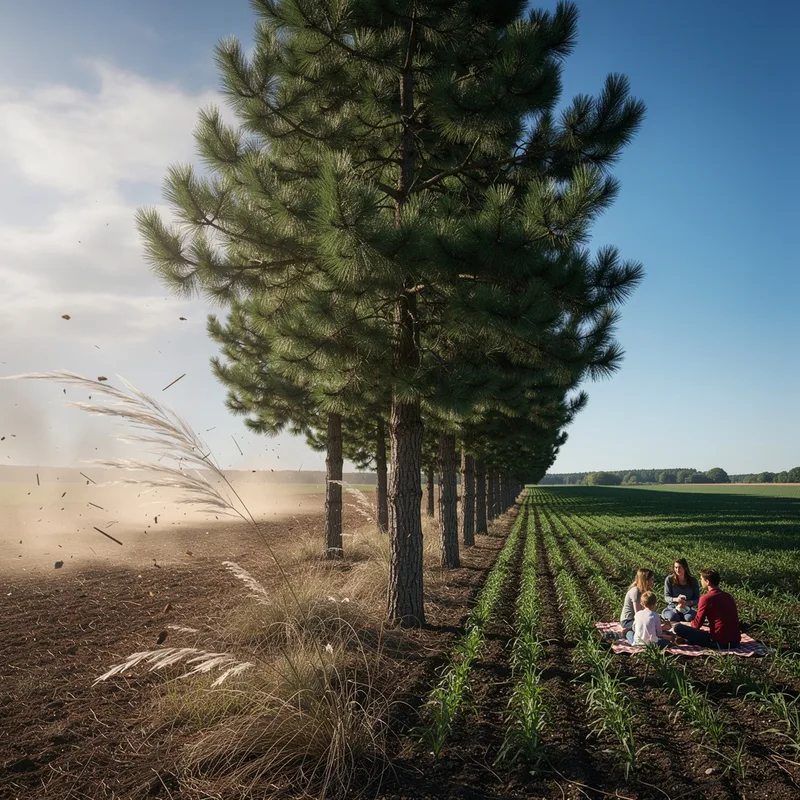
windbreak
 3
4.1
3
4.1

- noun
- /ˈwɪndˌbreɪk/
- Larger spirea bushes and rose of Sharon make good tall hedges for windbreaks.
Loading YouTube…
Watch on YouTubeThis river dried up now the flat deck of the river stretched away to the north at its margins, where the remains of the stone embankment formed a ragged windbreak.
- This river dried up now the flat deck of the river stretched away to the north at its margins, where the remains of the stone embankment formed a ragged windbreak.
Examples
-
We need to build a windbreak to protect the garden from strong winds while the plants are growing.
-
Much of the left part of the beach was taken up with the windbreak.
Fiction book (1998) -
We need to build a windbreak in order to make a fire or we're gonna freeze tonight.
-
The trees act as a windbreak, but the temperature, if anything, is dropping.
Fiction book (2000) -
Behind the house on the north, a row of tall poplar trees had been planted for a windbreak.
Fiction book (1993) -
North-side evergreens provide an effective windbreak and weather barrier.
Academic text (2007) -
A row of tall shrubs can serve as an effective windbreak to prevent soil erosion in the field.
-
To create a sheltered area for the picnic, we set up a windbreak made of wooden panels and bushes.
Synonyms

 1
6.7
1
6.7
A row of trees or bushes planted to protect fields from wind and soil loss
How Protective

Surface Forms
Morphology
Etymology
The word windbreak is made of wind ('moving air') and break ('to stop or reduce'). It names a row of trees or a fence that stops or reduces the wind, so it protects land and people from strong wind.