
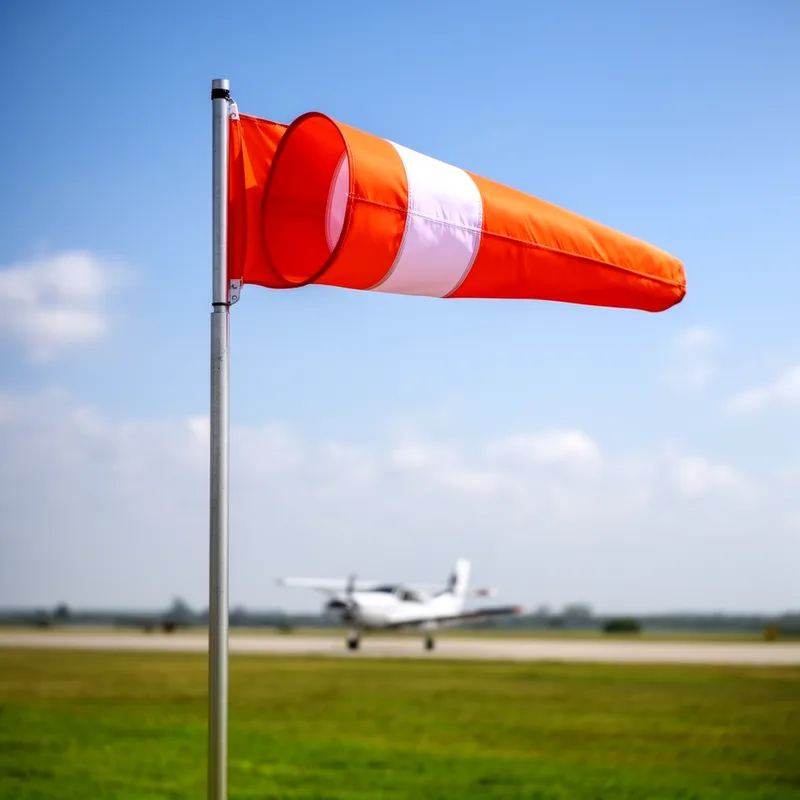
wind sleeve
- noun
- Specialized
- The airport replaced its torn wind sleeve with a new, brightly colored one so it was visible from a distance.
Examples
-
The wind sleeve at the airfield was pointing directly east, indicating a strong breeze from the west.
-
Pilots check the wind sleeve before takeoff to assess the wind's direction and intensity.
-
Look at that wind sleeve blowing in the wind!
-
The wind sleeve flapped vigorously in the strong breeze.
-
Pilots check the wind sleeve before takeoff to assess the wind's direction and intensity.
-
The wind sleeve at the airfield showed that the wind was blowing steadily from the northwest.
-
During the storm, the wind sleeve indicated gusts were over 30 miles per hour.
Synonyms
 28
8.2
28
8.2

A cone-shaped cloth tube on a pole that shows wind direction at airports
 2
5.1
2
5.1
A cloth cone on a pole that shows wind direction and strength, often at airports


 1
4.4
1
4.4
A cloth tube on a pole that shows wind direction and strength

A cloth cone on a pole that shows wind direction and strength
A cloth cone on a pole that shows wind direction and strength

A cloth cone on a pole that shows wind direction and strength at airports

A cone of cloth on a pole that shows wind direction, often at airports
Surface Forms
Morphology
The term is transparently compositional: a 'sleeve' (a tubular cover) associated with 'wind' clearly suggests a fabric tube that wind fills or moves, so learners can infer it shows wind direction/strength. This follows a common English noun+noun naming pattern (a sleeve for wind) and is conceptually similar across languages, so a B1 learner who knows both words can reasonably deduce the meaning.
Etymology
Wind sleeve comes from a simple picture: a cloth sleeve on a pole that fills with wind and points the way the air is moving. Because it 'shows' the wind's 'direction and strength', the name now means the cone used at airports and airfields to tell pilots how the wind is blowing.