
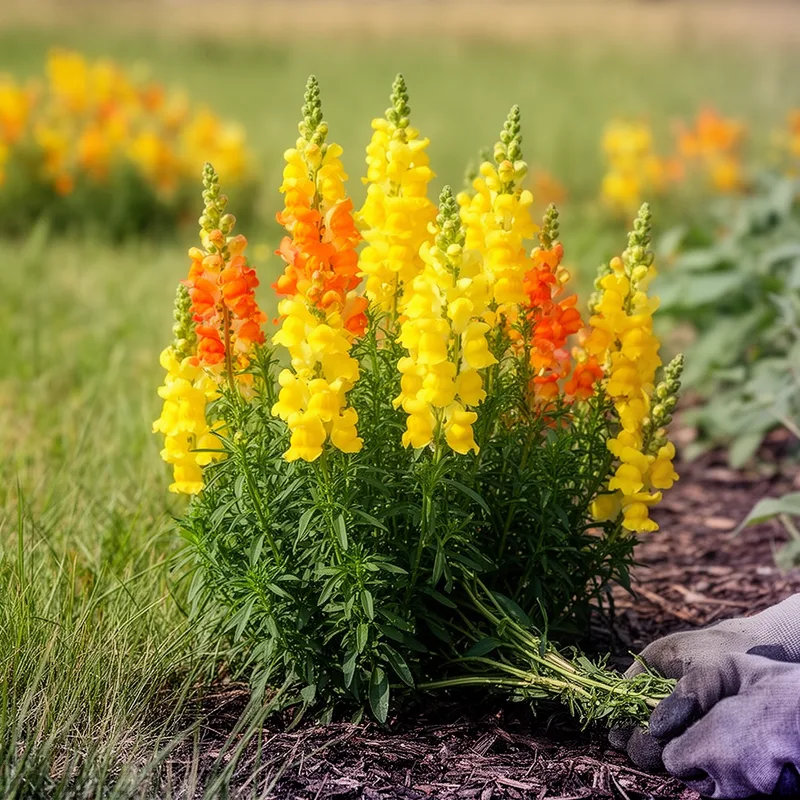
wild snapdragon
- noun
- /waɪld ˈsnæpˌdræɡən/
- UK
- The field was covered in wild snapdragon blooming in vibrant yellow and orange.
Loading YouTube…
Watch on YouTubeHow does this relate to what's going on in natural populations with wild snapdragons?
- How does this relate to what's going on in natural populations with wild snapdragons?
Examples
-
Gardeners often struggle to remove wild snapdragon when it spreads as a weed.
-
The wild snapdragon blooms in vibrant colors during spring.
-
Botanists observed that wild snapdragon has become naturalized in several parts of North America.
-
Have you seen a wild snapdragon in the garden?
-
In the summer, the garden was filled with wild snapdragon, showcasing its bright yellow and orange flowers.
-
Many farmers consider wild snapdragon a nuisance because it can quickly take over their crops.
-
During our hike, we spotted clusters of wild snapdragon growing along the sunny hillside.
Synonyms

A wild plant with yellow and orange flowers that spreads quickly in fields and roadsides

A small plant with bright yellow and orange flowers that often grows wild and spreads quickly

A plant from Europe with bright yellow and orange flowers often seen as a weed

A small plant with yellow and orange flowers often seen as a weed
Surface Forms
Morphology
The noun phrase is a straightforward composition of 'wild' (growing naturally/not cultivated) and 'snapdragon' (a type of plant), so its meaning — a snapdragon growing in the wild — is directly derivable from the constituents. This adjective+noun pattern is cross-linguistically common and follows regular English composition, making it easily understandable to a B1 learner who knows both words.
Etymology
Wild snapdragon gets its name from the flower's shape: it looks like a small dragon and if you press its sides the 'mouth' seems to snap open and shut. One popular story says people called these wild plants 'snapdragons' for that snapping, so the name now refers to the European plant with bright yellow and orange flowers often found as a weed.

