

wild red oat
- noun
- UK
- Scientists consider the wild red oat to be the primary ancestor of domesticated oats.
Examples
-
The wild red oat is often found in Mediterranean regions.
-
Efforts to protect wild red oat populations are important for preserving genetic diversity in crops.
-
The wild red oat is commonly found in Mediterranean regions.
-
Farmers are interested in wild red oats for their genetic traits.
-
Scientists consider the wild red oat to be the primary ancestor of domesticated oats.
-
Efforts to protect wild red oat populations are important for preserving genetic diversity in crops.
-
The wild red oat is commonly found in Mediterranean regions.
Synonyms

A wild Mediterranean oat thought to be the ancestor of the oats we grow today
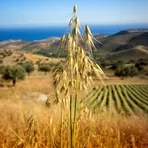
A wild oat that grows in the Mediterranean and is an ancestor of the oats we grow
Surface Forms
Morphology
The phrase is a straightforward compound noun built from 'wild' (not domesticated) + 'red' (color) + 'oat' (the cereal plant), so a learner who knows the constituents can infer it denotes an oat that is wild and red. The specific botanical detail (a Mediterranean species and ancestor of cultivated oats) is encyclopedic but does not make the basic referent unpredictable; such modifiers are compositional and cross-linguistically common.
Etymology
Wild red oat may come from the plant's look: a wild grass with small red seeds that people long ago called an oat. Farmers later used these wild plants to make the oats we eat today, so the name shows it is the 'ancestor' of modern oats.

