
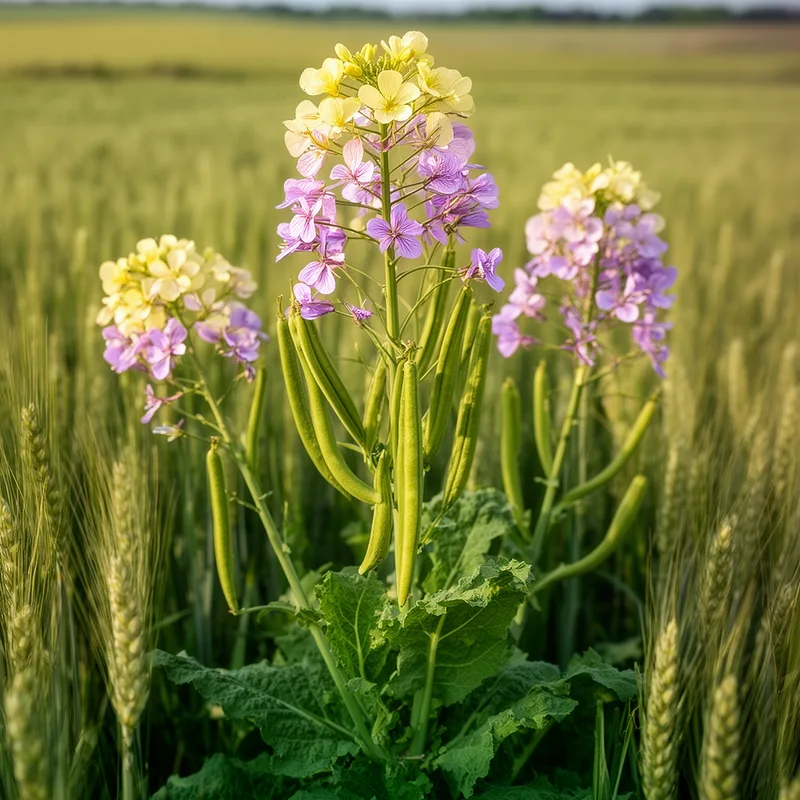
wild radish
- noun
- /waɪld ˈrædɪʃ/
- UK
- Many farmers consider wild radishes to be weeds.
Examples
-
Gardeners struggle to control wild radish because of its rapid growth and prolific seed production.
-
Wild radish often invades cereal crop fields, competing with the desired plants for nutrients.
-
The flowers of the wild radish can range from pale yellow to light mauve, adding color to the meadows.
-
The wild radish grows abundantly in fields.
-
In her garden, she discovered some wild radish plants with vibrant yellow flowers.
-
The salad was topped with colorful wild radish blossoms for extra flavor.
-
Farmers often pull out wild radish from their fields because it can take over space meant for crops.
Synonyms


 1
9.9
1
9.9
A wild plant like mustard with yellow, white, or purple flowers often seen as a weed

A wild radish plant with yellow, white, or purple flowers and seed pods that often grows as a weed
Surface Forms
Morphology
The meaning 'a radish that grows in the wild' is directly and compositionally derived from 'wild' (not domesticated) + 'radish' (the root vegetable); it denotes a non-cultivated radish or weed. This straightforward compound follows common language patterns and requires no idiomatic knowledge, so a B1 learner who knows both constituents will readily understand it.
Etymology
Wild radish is a plain, literal name: radish is a common root plant and wild shows it grows by itself in fields and roadsides. Because it often spreads quickly and is not planted by gardeners, people call it a 'weed' today.