
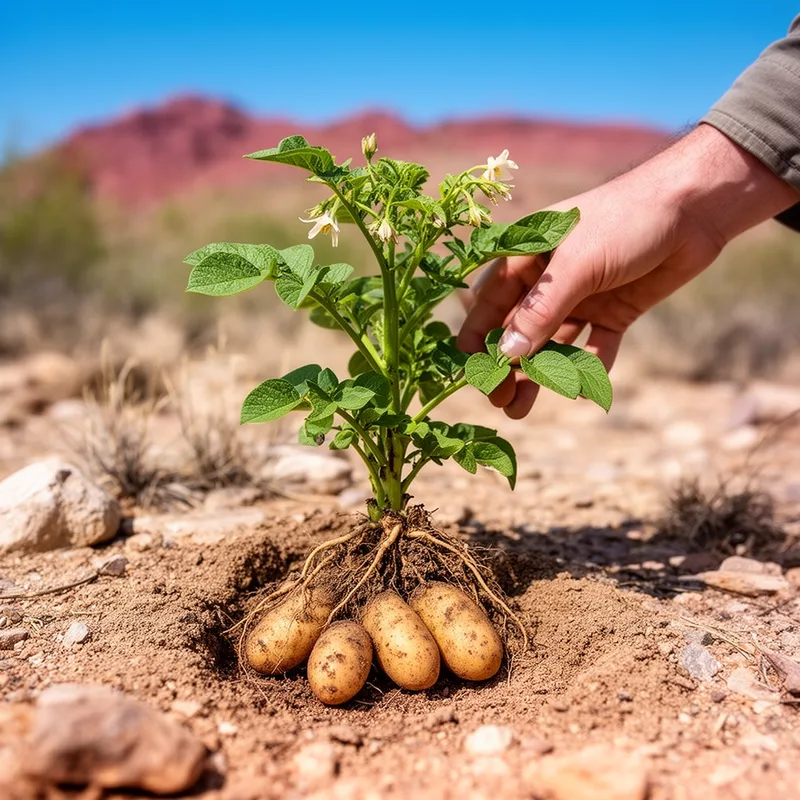
wild potato
- noun
- /waɪld pəˈteɪtoʊ/
- US
 :
papa silvestre
:
papa silvestre
- In Southwestern United States, wild potato varieties are valued for their resilience against diseases.
- wild potato species
Examples
-
PHOTO (COLOR): Although small tubers are typical of wild potato sidles, geneticist John Bamberg says genes for desirable characteristics may also be present.
Academic text (1998) -
Researchers discovered that wild potato plants can thrive even in poor soil conditions.
-
Germplasm like these wild potatoes is becoming more and more valuable.
Academic text (1998) -
Hedysarum alpinum is wild potato root.
-
"Potato remains recently discovered in ruins now also provide the first solid evidence that the wild potato species were used by ancient native people in the region," says Bamberg.
Academic text (1998) -
"We know that wild potato species resist the fungus that causes blight," Helgeson explains.
Academic text (1994) -
He fused leaf cells from a wild potato species with leaf cells from a cultivated variety to develop what is called a somatic hybrid.
Academic text (1994) -
PHOTO (COLOR): Data specialist Jesse Schartner (left) and geneticist John Bamberg examine wild potato plants grown out from seed stored at the U.S. Potato Genebank.
Academic text (1998) -
Young, who collaborates with Deahl, is testing germplasm supplied by the ARS Vegetable Lab, as well as looking for the genes in wild potato species that resist P. infestans.
Academic text (1994) -
Researchers are preserving the genetic diversity of this pair of wild potatoes in two ways: ex situ—in the artificial environment of genebanks; and in situ—where nature placed them.
Academic text (1998)
Synonyms
A plant that lives for several years and makes small potato-like tubers in dry, rocky soil

A wild potato plant from South America used in breeding for disease resistance
Surface Forms
Morphology
The noun phrase is a straightforward composition of 'wild' (growing naturally, not domesticated) + 'potato' (the tuber/plant), so the meaning—a potato-like plant growing in the wild—is directly derivable from the parts. This adjective+noun pattern is cross-linguistically common, so a B1 learner who knows both words should be able to infer the referent without prior exposure.
Etymology
Wild potato gets its name from the plant's small, potato-like underground parts. The word potato shows it looks like a farm 'potato' and the word wild shows it grows in nature, so the name means 'a potato-like plant that grows without farming'.

