
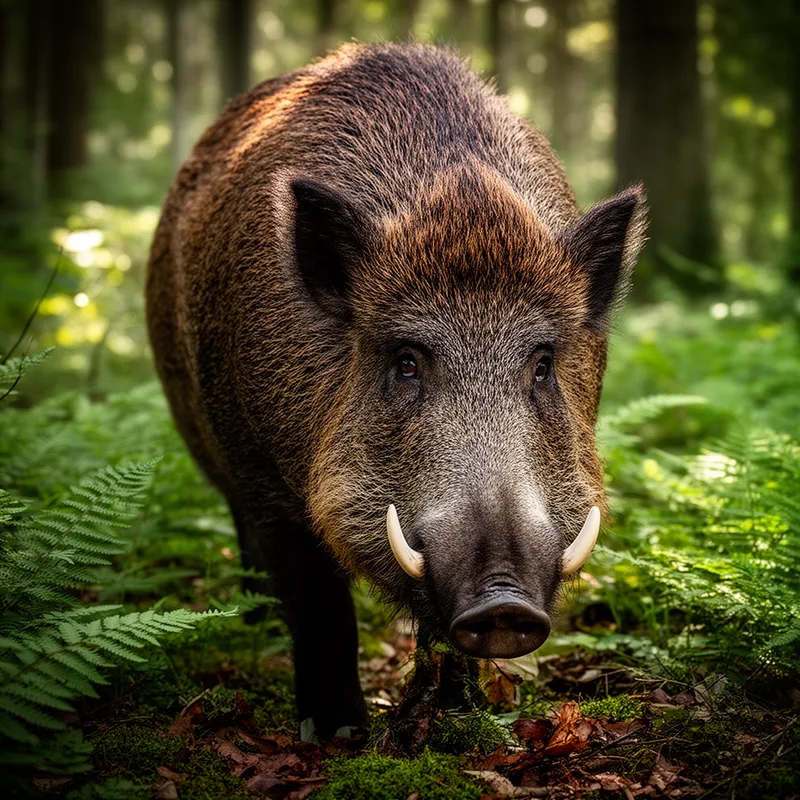
wild boar
 9
3.4
9
3.4

- noun
- /waɪld bɔr/
- We sat under a tent and ordered the local special meal of "Corn Lain" and barbecued wild boar on a stick.
- wild boar meat
- prey such as wild boar
Loading YouTube…
Watch on YouTubeBesides the mud oven, two wild boar heads sizzling sizzled in a cradle of embers.
- Besides the mud oven, two wild boar heads sizzling sizzled in a cradle of embers.
Examples
-
We see the camera scan, and we see two large wild boars in a pen.
Fiction book (2001) -
The research team saw several confrontations between the adult wolves and wild boars.
Academic text (1996) -
Taught him how to kill a wild boar with a stick.
-
Sounds like a wild boar on the make.
-
I want you to give me a wild boar.
-
My father died defending her from a wild boar.
-
However, almost all of the 50 study participants had consumed wild boar meat.
Academic text (2012) -
A wild boar has invaded thy vineyard.
-
Wild boar meat cutlets, potato chunks, fennel and some local wild herbs.
-
No more than ten yards away, a giant wild boar was digging at the grass.
Synonyms
 24
2.9
24
2.9
A wild pig with tusks that lives in forests and is the ancestor of most farm pigs
A wild pig from Europe, Asia, and North Africa that is the ancestor of most farm pigs
Surface Forms
Morphology
The meaning 'a large, wild pig...' is directly and predictably composed from 'wild' (not domesticated) + 'boar' (a pig), following the common adjective + noun compounding pattern. This straightforward, cross-linguistically common composition makes the referent immediately inferable to a B1 learner who knows both constituents.
Etymology
The noun wild boar comes from the simple image of wild meaning 'living in nature' and boar meaning 'pig'. Think of a big pig with long tusks running through the forest, and that's why the phrase means 'a large, wild pig'.