
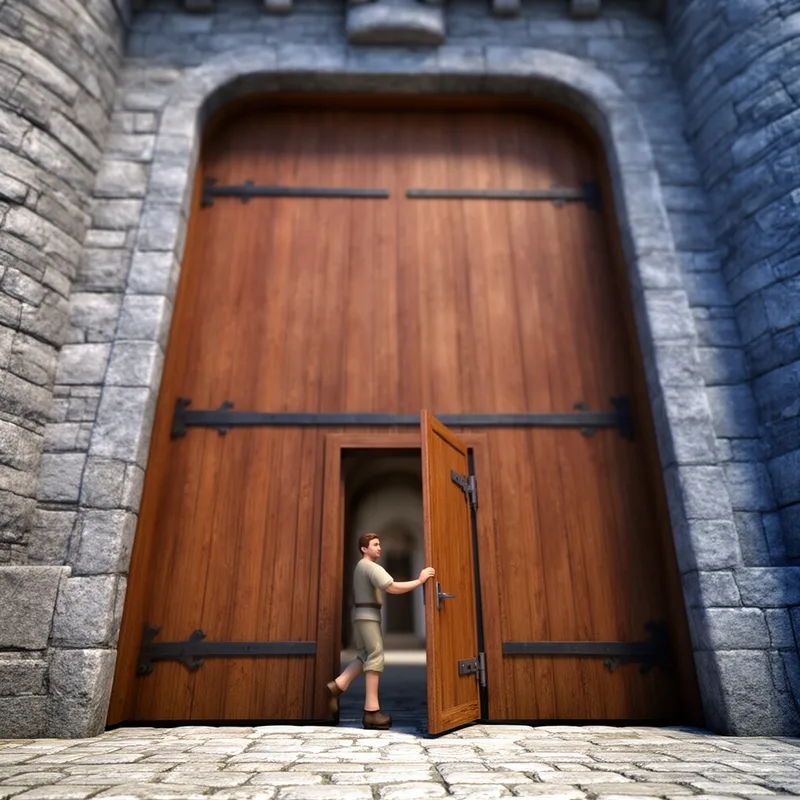
wicket door
- noun
- /ˈwɪkɪt dɔr/
- The castle’s massive gates included a wicket door for the guards to pass through without opening the main entrance.
Examples
-
Please use the wicket door at the side if you arrive after hours.
-
She stepped through the wicket door to get to the garden.
-
Medieval cathedrals often had a wicket door so visitors could enter quietly.
-
The wicket door swung open as the crowd entered.
-
Please use the wicket door at the side if you arrive after hours.
-
The castle’s massive gates included a wicket door for the guards to pass through without opening the main entrance.
-
She stepped through the wicket door to get to the garden.
Synonyms


 1
7.5
1
7.5
A small gate set inside a larger gate or door to let people through

A small gate in or beside a larger gate that lets you enter without opening it
How Big

Surface Forms
Morphology
The meaning 'a small door built into a larger door' is directly and compositionally derived from 'wicket' (a little gate/door) + 'door'; the compound simply specifies a smaller door and follows normal noun-noun compounding patterns. Given knowledge of both constituents, a B1 learner can immediately infer the meaning, and the concept is cross-linguistically common.
Etymology
The noun wicket door comes from a tiny inner gate called a wicket built into a large door or gate, so one person could slip through without opening the main entrance. That's why today wicket door means 'a small door or gate for one person'.