

whitetail jackrabbit
- noun
- /ˈhwaɪtˌteɪl ˈdʒækˌræbɪt/
- US
- Upon the arrival of winter, the fur of the whitetail jackrabbit changes to a white color to help it camouflage in the snow.
Examples
-
During the summer, the whitetail jackrabbit's coat turns a brownish-grey to blend in with the landscape.
-
Farmers in the region often spot a whitetail jackrabbit bounding across the fields at dusk.
-
The whitetail jackrabbit is well adapted to survive the harsh winters of the northern plains.
-
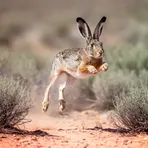
The whitetail jackrabbit is known for its incredible speed.
-
Many people have never seen a whitetail jackrabbit in the wild.
-
The whitetail jackrabbit can often be seen hopping through the bushes during the warm summer months.
-
While hiking in the mountains, I spotted a whitetail jackrabbit darting away from my approach.
Synonyms
 12
4.5
12
4.5

A large fast hare of western North America with very long ears and strong back legs

A large hare with a white tail and fur that becomes paler in winter
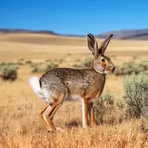
A large hare with a white tail that lives in western United States plains
Surface Forms
Morphology
whitetail + jackrabbit
The noun is transparently compositional: 'whitetail' is interpretable as 'white tail' and 'jackrabbit' is a known hare, so a learner who knows those constituents can infer it refers to a jackrabbit with a white tail. Specific taxonomic or regional details (e.g., range, size) are not derivable, but the core meaning is clearly built from the parts and is cross-linguistically predictable.
Etymology
Whitetail jackrabbit comes from two simple images: the hare's bright white tail that flashes like a small flag when it runs, and an old name 'jackass rabbit' that was shortened to jackrabbit because its long ears looked a bit like a donkey's. So the name tells you it is a large hare with a white tail.