
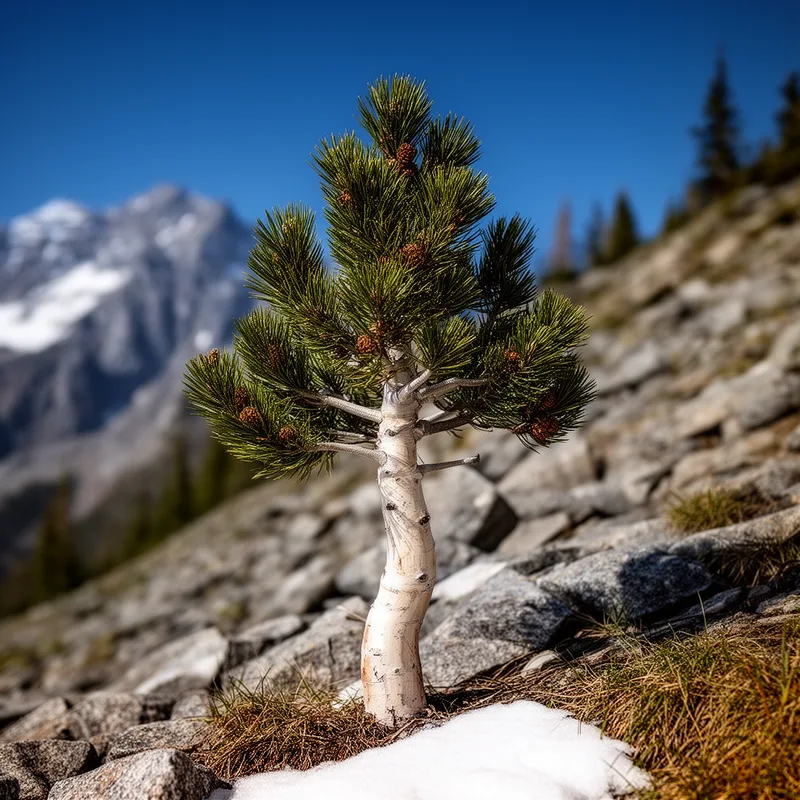
whitebark pine
- noun
- /ˈwaɪtbɑrk paɪn/
- US
- This was the first of August, however, and the skeletal trees were whitebark pines, not seasonally dormant but long dead.
- whitebark pine tree
- whitebark pine stands
Examples
-
If you dug through the duff and looked closely at the living roots of a whitebark pine, you’d find them wrapped in a net of fungal threads.
Academic text (1998) -
Wildlife, including squirrels and birds, depend on the seeds of the whitebark pine for their survival.
-
Stands of dead whitebark pines surround Glacier National Park's Old Man Lake above.
Academic text (1998) -
The ability to survive in such conditions makes the whitebark pine often the first tree to appear in high-elevation burned, clear-cut, or otherwise disturbed sites.
Academic text (1998) -
As whitebark pines succumb to a foreign fungus, the birds and the bears may suffer, too.
Academic text (1998) -
PHOTO (COLOR): Where healthy stands remain, whitebark pine nuts are an important part of the grizzly bear's autumn diet.
Academic text (1998) -
The forest was filled with the tall silhouette of whitebark pine trees stretching toward the sky.
-
Ecologists are studying the decline of whitebark pine due to climate change and invasive species.
Synonyms

A high mountain pine from western North America with white bark and groups of five needles

A small pine tree with smooth white bark that grows in western North American mountains
Surface Forms
Morphology
whitebark + pine
The compound is transparently descriptive: it combines 'white' + 'bark' with 'pine' to denote a pine tree that has pale or white bark, so the overall meaning is directly derivable from the parts. Even though 'whitebark' may not appear as an independent dictionary entry, the descriptive composition follows regular English compounding patterns and would be clear to a B1 learner who knows the constituent words.
Etymology
Whitebark pine gets its name from a simple picture: the tree has pale, smooth bark, so people put white and bark together and added pine because it is a pine tree. That's why the name means 'a pine with light-colored bark', often seen as a small tree high in the mountains.

