

to white out
 1
3.9
1
3.9

- phrasal verb
- /ˈwaɪt aʊt/
- US
- So I sneak up to my room and I white out the "D" so it looks like a "B," which I did flawlessly.
Loading YouTube…
Watch on YouTubeThey had whited out the Silver Star and wrote bronze with V and pen.
- They had whited out the Silver Star and wrote bronze with V and pen.
Examples
-
I opened a bottle of liquid paper and whited out the line.
Fiction book (1991) -
Now take your white face paint and with your brush, paint to white out the bone area.
-
When's the last time you used white out, bro?
-
They had whited out the Silver Star and wrote bronze with V and pen.
-
I opened a bottle of correction fluid to white out the mistakes on my report before submitting it.
-
He used a brush to white out the incorrect numbers in his final draft.
-
Before handing in her assignment, she decided to white out the errors that were marked in red.
Synonyms
 8
5.4
8
5.4
Hide something so you cannot see it or remember it
 1
4.3
1
4.3
Erase a mark by using an eraser or cloth until it disappears


 1
6.4
1
6.4
To remove words or other information from a document to hide them
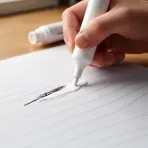
To cover a mistake in writing with white correction fluid
Antonyms

Surface Forms
Morphology
white + out
The sense 'to cover writing with white correction fluid' is directly derivable from combining 'white' (to make white) with the particle 'out' (meaning completely/cover over); a B1 learner who knows both constituents can infer the action of making marks white to hide them. This follows a common verb+particle composition pattern in English and is cross-linguistically plausible, so the expression is transparently compositional.
Etymology
White out comes from using white correction fluid to cover words on paper. You put white over a mistake to make it out of sight, so the phrase means 'to hide' writing by covering it.