
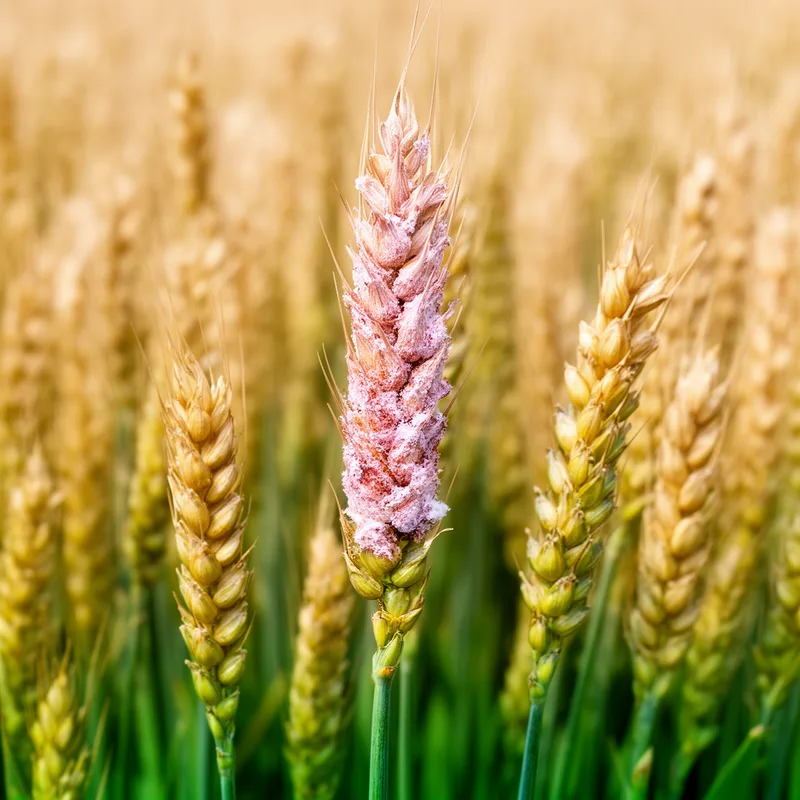
wheat scab
- noun
- Specialized
 :
costra del trigo
:
costra del trigo
- Wheat scab is caused by the fungus Fusarium graminearum.
Examples
-
It may require new types of genetic controls because the traditional solution of breeding resistant crops doesn't seem to work well with wheat scab.
Academic text (2006) -
The emergence of other diseases, such as wheat scab, has complicated efforts to develop rust-resistant wheat varieties.
Academic text (2006) -
Where resistance isn't enough, as in the case of wheat scab, they use new strategies, such as genetic interference in the plant-pathogen interaction.
Academic text (2006) -
In research to control the spread of cereal pathogens, geneticist Todd Ward uses DNA sequence data to track the global distribution of wheat scab.
Academic text (2000) -
Besides Ug99, CDL scientists are currently watching for new races of stripe rust, leaf rust, and wheat scab.
Academic text (2006) -
Microbiologist Kerry O'Donnell stores genetically characterized wheat scab pathogens in liquid nitrogen for future studies.
Academic text (2000) -
The occurrence of wheat scab can substantially diminish the yield of infected wheat fields.
-
Farmers must carefully monitor their crops for signs of wheat scab during the growing season.
-
The recent outbreak of wheat scab has farmers concerned about their harvests this year.
Surface Forms
Morphology
wheat + scab
The phrase is compositional: 'wheat' (the crop) + 'scab' (a crusty lesion or disease symptom) yields a disease/lesion affecting wheat. This follows a common pattern in English (e.g. 'apple scab', 'potato scab'), so a B1 learner who knows both constituents can reliably infer it refers to a plant disease on wheat.
Etymology
Wheat scab comes from the word scab, a crusty sore on skin, because the fungal spots on the wheat heads look like a 'scab'. So wheat scab means a 'disease' that harms the grain and can lower the harvest.

