
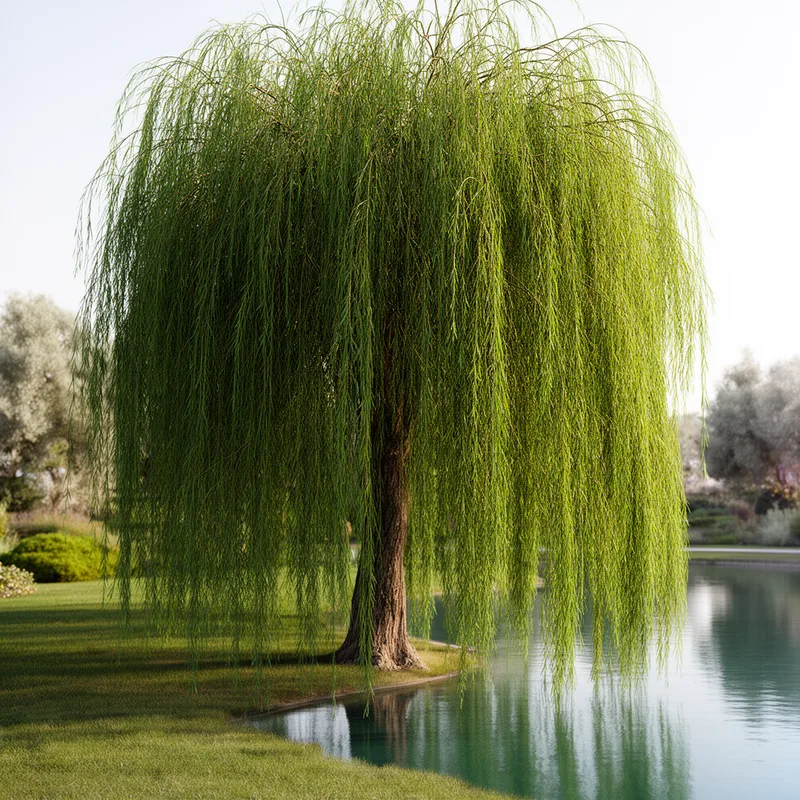
weeping willow
 2
3.1
2
3.1

- noun
- /ˈwiːpɪŋ ˈwɪloʊ/
- Drew runs through a large city park, stopping to watch a group of older citizens going through Tai Chi routines under the weeping willow trees there.
- weeping willow tree
- boughs of the weeping willow
- shaded by a weeping willow
Examples
-
On a small knoll near the fence stood a weeping willow tree.
Fiction book (1993) -
Why couldn't they dine in the shade of a weeping willow today?
Fiction book (1996) -
Did you see the weeping willow they got up that street?
Fiction book (1993) -
I got to a weeping willow tree where I broke off a branch.
Fiction book (1997) -
There was a small pond next to an old weeping willow.
Fiction book (1999) -
She was smiling in the picture and standing under a weeping willow tree.
Fiction book (1990) -
Two enormous weeping willows were in the front yard, on either side of the driveway.
Fiction book (1993) -
The trees that line the banks of the river are just starting to bud, and the weeping willows trail in the water, tugged gently by the current.
Fiction book (1998) -
We floated through islands of lily pads and under the sprawling weeping willows.
Fiction book (1995) -
The dog was sleeping beneath the weeping willow in the yard.
Synonyms

A willow tree with long, drooping branches and thin leaves often called weeping willow

A tree with long drooping branches and thin leaves often planted near ponds for shade
Surface Forms
Morphology
The meaning is directly compositional: 'weeping' (having drooping branches) modifies 'willow' (a Salix tree), so 'a willow with long, drooping branches' is immediately derivable from the parts. This adjective+noun naming pattern is common in English and has clear cross-linguistic parallels, so a B1 learner who knows both constituent meanings will readily understand it.
Etymology
Weeping willow was named for its long branches that hang down like tears, so the tree looks as if it is weeping. That's why the name now means a willow tree with long, drooping branches.