
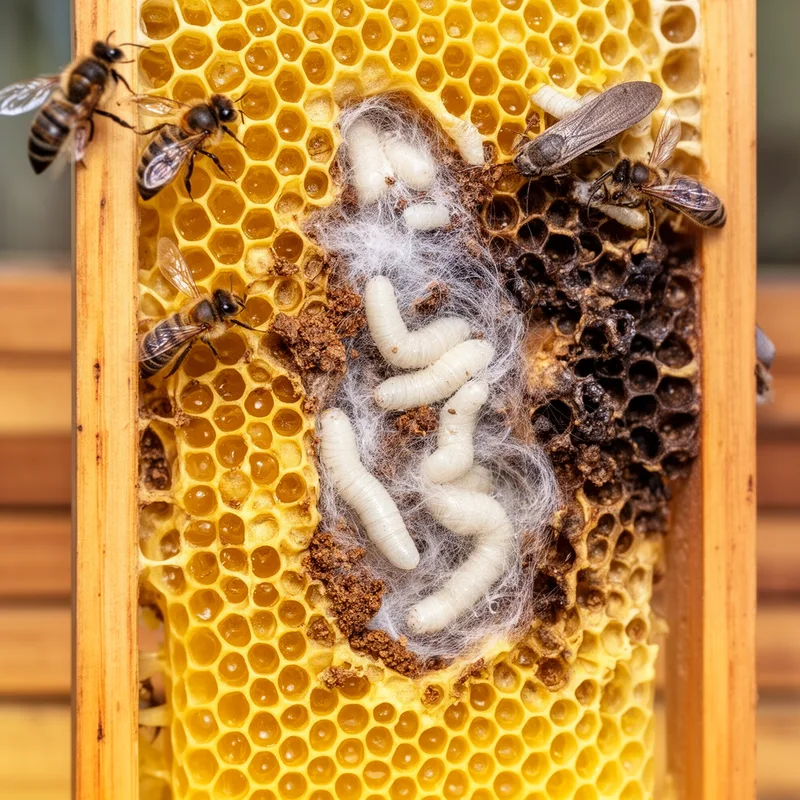
wax moth
- noun
- /wæks mɔθ/
- The wax moth larvae can destroy entire beehives if left unchecked.
Examples
-
Beekeepers must regularly inspect their hives for signs of wax moth infestation.
-
During early research, they used cadavers of Tenebrio molitor, commonly known as the yellow mealworm, and Galleria mellonella, or greater wax moth.
Academic text (2002) -
The presence of a wax moth in a honeycomb indicates potential damage to the colony.
Synonyms

A moth whose caterpillars live in beehives and eat honeycomb, often damaging hives

A small moth whose larvae eat wax and honeycomb in beehives
Surface Forms
Morphology
The compound 'wax moth' is directly compositional: 'wax' specifies the substance and 'moth' the insect, so the phrase denotes a moth associated with wax (e.g., feeding on honeycombs). This noun+noun naming pattern (host/substrate + animal) is common cross-linguistically, so a B1 learner who knows both constituents can readily infer the meaning.
Etymology
The noun wax moth comes from a moth whose young eat the wax inside beehives. Its caterpillars tunnel through the 'honeycomb' and can 'damage' the hive, so the name shows what the insect does.

