
wavefunction
 2
8.2
2
8.2

- noun
- /ˈweɪvˌfʌŋkʃən/
- Specialized
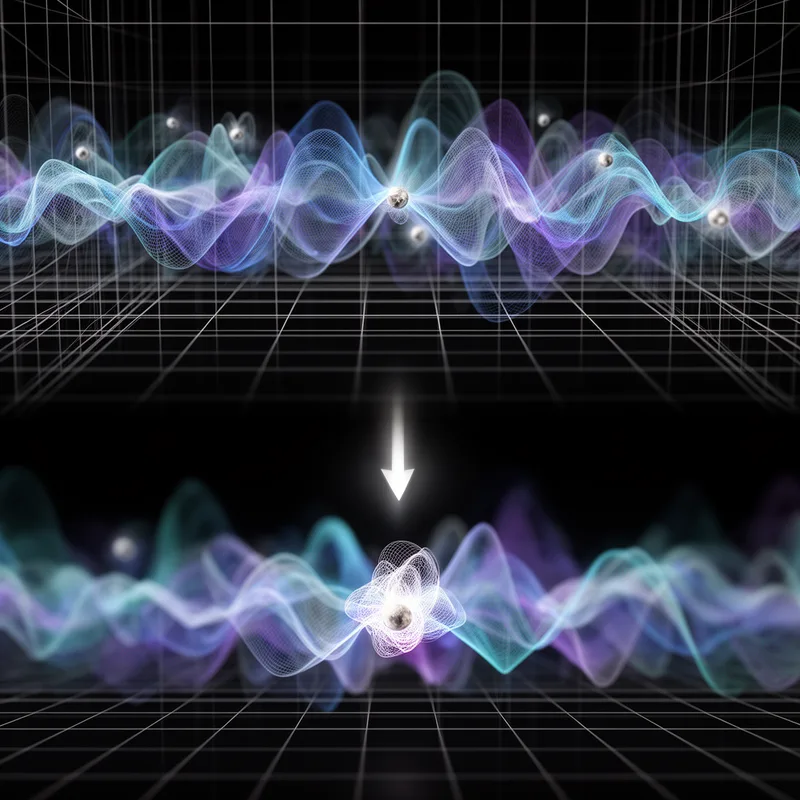
- The wavefunction describes the probability of finding a particle in a given position.
- envelope wavefunction
- electronic wavefunction
- electron wavefunction
Examples
-
Colors represent the magnitude of the wavefunction, with yellow indicating the greatest magnitude.
Academic text (2012) -
Because their charge-carrier wavefunctions are confined in all three dimensions, quantum dots, like atoms, have discrete energy levels.
Academic text (2012) -
And, and so somehow what you, what you write for the wavefunction will reflect that.
-
So that is actually the consequence of this wavefunction interpretation.
-
But how do we determine the condensate wavefunction when interactions are present?
Academic text (1999) -
Consequently, it is possible to control the full quantum mechanical wavefunction of a QD.
Academic text (2002) -
Thanks to these advantages, it is possible to probe and manipulate the wavefunction of a single QD.
Academic text (2002) -
In an ideal gas, Bose-condensed atoms would all occupy the same single-particle ground state wavefunction.
Academic text (1999) -
The number of Cooper pairs and the phase of the wavefunction in a superconductor are conjugate variables.
Academic text (2004) -
By insisting that the wavefunction be single-valued, one obtains the Bohr-Sommerfeld quantization condition, equation 1.
Academic text (2005)
Synonyms
 5
8.0
5
8.0
A math rule in quantum physics that shows how likely a particle is to be in a certain place
Surface Forms
Morphology
Etymology
The word wavefunction breaks into two familiar parts: wave, meaning 'a rising and falling shape like water or sound', and function, meaning 'a math rule'. So a wavefunction is a mathematical rule that looks like a wave and tells us how a tiny particle behaves and where it is likely to be found.