
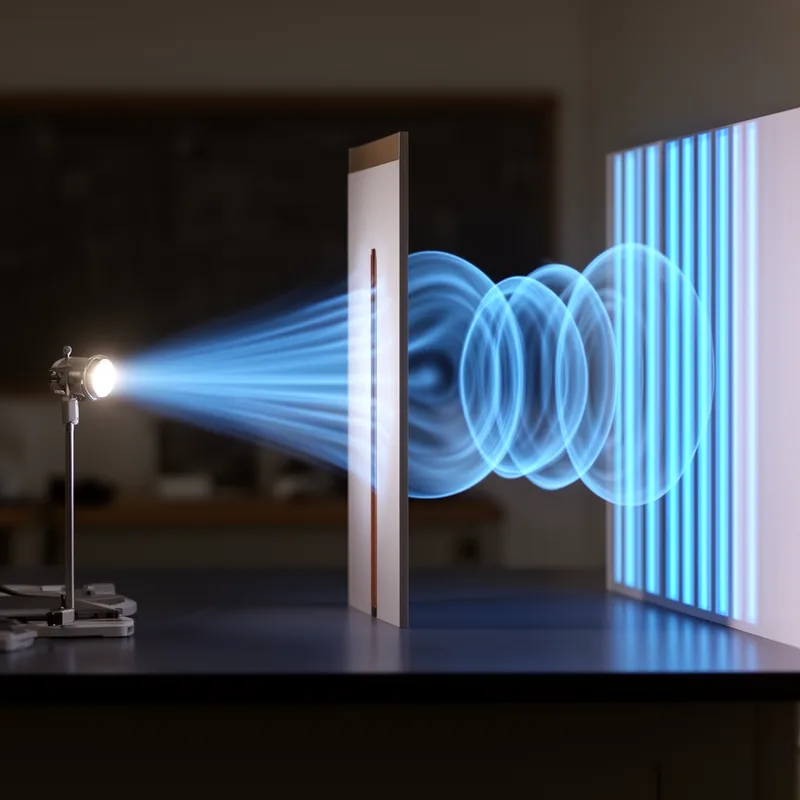
wave theory of light
- noun
- /weɪv ˈθɪəri əv laɪt/
- Specialized
- The scientist presented the wave theory of light as a breakthrough in understanding how light behaves in different mediums.
Loading YouTube…
Watch on YouTubeI once wrote a book on the origins of wave theory of light, and that is one of the paradigmatic examples that Tom used.
- I once wrote a book on the origins of wave theory of light, and that is one of the paradigmatic examples that Tom used.
Examples
-
The wave theory of light helps explain phenomena like diffraction, where light bends around corners.
-
Thought only began to take a new turn with the wave theory of light and the theory of the electromagnetic field of Faraday and Maxwell.
Academic text (2009) -
Many experiments support the wave theory of light, showing how waves can interfere with one another.
Synonyms


 1
5.6
1
5.6
The idea that light and energy move as waves rather than particles

A scientific idea that light travels as waves rather than particles
Antonyms

- Archaic
The idea that light is a stream of tiny particles rather than a wave
How Advanced

Surface Forms
Morphology
The meaning is directly compositional: it denotes a theory that explains light in terms of waves, which a learner can infer from 'wave' + 'theory' + 'of' + 'light'. The 'X theory of Y' construction is cross-linguistically common and follows standard noun-noun composition, so a B1 learner who knows the constituent words would readily understand it.
Etymology
Wave theory of light comes from the simple image of ripples on water: scientists imagined light moving like a wave that can meet other waves and bend around things. That's why the idea explains 'interference', when waves meet and change, and 'diffraction', when waves bend around edges, so it means that light travels as a wave.