
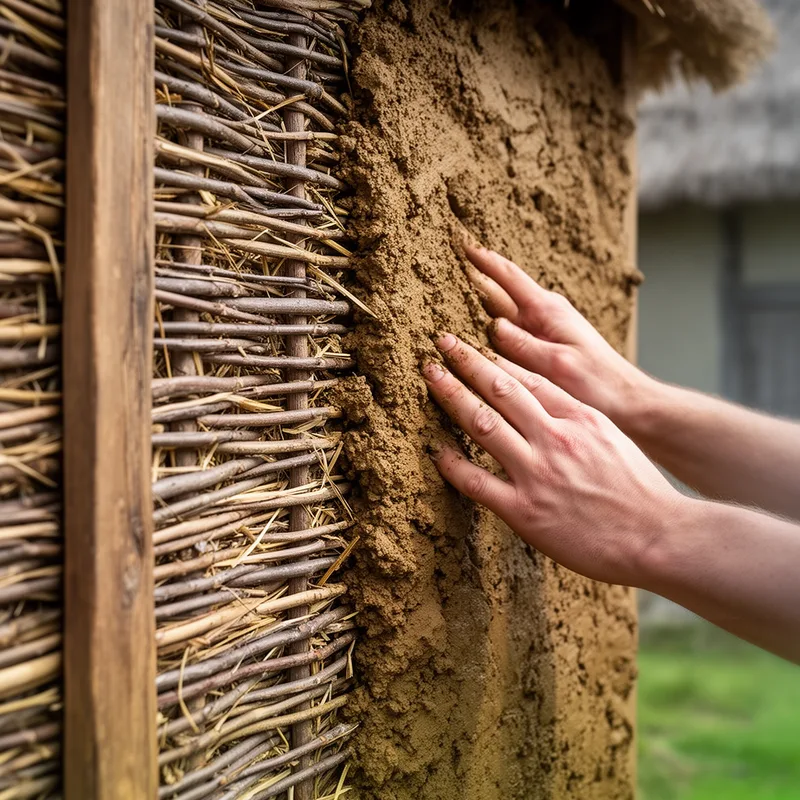
wattle and daub


 1
9.9
1
9.9
- noun
- /ˈwɒtəl ənd dɔːb/
- I stared at Ruth's still body, and the scene crumbled before me with the wattle and daub, blown apart by a mortar shell.
- wattle and daub house
- wattle and daub structure
Examples
-
The middle section of the house was a wattle and daub (Shakespearean era) building.
Blog text (16) -
There was lots of burned clay—the daub from the wattle-and-daub structure—baked very hard in tremendous quantities.
Academic text (2006) -
From the outside, the house was a run-of-the-mill wattle-and-daub structure, but as soon as I stepped inside, I knew I was in the presence of an exceptional individual.
Academic text (2004) -
The walls were made of a sophisticated type of wattle-and-daub covered with high-quality plaster painted with a red and black strip along the base.
Academic text (2010) -
They build typical Masikoro wooden or wattle-and-daub single-room houses.
Academic text (1991) -
These rooms were built of wattle-and-daub and adobe bricks, some of which were reused from prehistoric structures.
Academic text (2011) -
Gokcay points out two more "greenhouses" in a low, flooded area that mark the locations of two wattle-and-daub structures discovered by archaeologist Mehmet Ali
Academic text (2007) -
This year, Higham's team has found Iron Age butchering floors, a collapsed wattle and daub house, and a cemetery with 60 bodies crammed like sardines.
Academic text (2006) -
A clearing appeared, and little thatched clusters of round wattle-and-daub huts with sheepfolds and cattle corrals around; the cold breeze ruffled rain-dimpled puddles.
Fiction book (2000) -
They build typical Masikoro wooden or wattle and daub single-room houses.
How Durable

Surface Forms
Morphology
Both constituents refer to the actual materials/process — 'wattle' is a woven lattice of sticks and 'daub' is a clay plaster — and the phrase literally names the building technique combining them. The meaning is directly compositional and follows a straightforward English noun-coordination pattern, so a B1 learner who knows the parts should be able to infer the full sense.
Etymology
Wattle and daub comes from an old building method: people wove thin branches into a frame called wattle and then covered it with clay or mud called daub. That's why the name means 'a wall material made from a woven frame and mud'.