

water table
 10
3.9
10
3.9

- noun
- /ˈwɔːtər ˈteɪbəl/
- Specialized
- A further complication involves the heavy clay soil and high water table near the creek.
- a high water table
- the water table rose
- the water table fell
Loading YouTube…
Watch on YouTubeAnd we're like, oh, they're so close to the water table.
- And we're like, oh, they're so close to the water table.
- And without this lower peat layer, the boggy conditions where the water table was quite high and the top surface was quite saturated, all of that is lost.
- And of course represents a threat to groundwater again as it goes down the the water table and into the sandstone formations for we hope permanent containment.
Examples
-
For example, the water table in Beijing is dropping at a rate of 1.5 meters every year.
Academic text (2000) -
You know, I think we're below the water table.
-
Every year the water table goes down.
-
And that is very far away from the water table.
-
Regardless of which figure is correct, water tables are rising, and relatively quickly.
Academic text (2003) -
As a result, water tables are falling and wells are going dry.
Academic text (2003) -
As people withdraw quantities of the underground water, the upper level of the water table drops.
Academic text (1996) -
In the agricultural state of Guanajuato, the water table is falling by two meters or more a year.
Academic text (2008) -
As a result of the further drainage of this wastewater into the groundwater, the water table has risen significantly.
Academic text (2003) -
When construction began, the church discovered that the water table was higher than expected.
Synonyms

 1
4.1
1
4.1
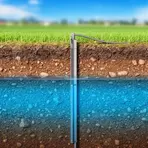
The height below the ground where the soil is full of water
Surface Forms
Morphology
The compound relates 'water' to a spatial/level sense of 'table' (a flat layer or level), so the notion of a layer or level of water is partially inferable. However, most B1 learners know 'table' primarily as furniture and would not automatically access the geological sense 'level/plateau', so the precise subterranean meaning is not fully predictable without prior exposure.
Etymology
Water table may come from the image of a flat table under the ground where water collects and stays. So the phrase describes the level below the ground that is filled with water, which is why it means the 'level where the ground is full of water'.