

washerwoman
 3
7.2
3
7.2

- noun
- /ˈwɔːʃərˌwʊmən/
- Archaic
- The washerwoman carefully washed and pressed the clothes before returning them to her clients.
Examples
-
Matilda even took in work as a washerwoman.
Fiction book (2002) -
There's not a washerwoman in this town that could save this dress.
-
You got a new washerwoman, I see.
-
A washerwoman brought up a dispute over a heating bill.
Fiction book (1992) -
In the song, Bessie Smith sings of the cares and woes of a washerwoman.
Academic text (2008) -
Their father, Ernesto Montez, had been a petty thief; their mother a washerwoman.
Fiction book (1994) -
When interviewed by a pension official in 1893, Ellen Davis stated that she was fifty-nine years old, employed as a washerwoman, and that she was born in Scotland.
Academic text (2005) -
Harmonia is a washerwoman and mother of many, a healer of festered wounds and a comfort to every barefoot boy and girl.
Fiction book (1992) -
In the case of the washerwoman, it is a sound—the shouts of the fleeing man—that throws her into a panic.
Academic text (2004) -
Her mother: Sophie, a Polish-Jewish washerwoman, a cook, and a chicken plucker from Kutno, a peeler of potatoes in a shtetl somewhere in the wilds of Eastern Europe.
Fiction book (2001)
Synonyms
 10
1.8
10
1.8
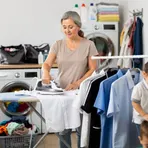
A person who washes clothes or sheets for a living
 3
7.3
3
7.3
A woman who washes and irons clothes for other people
 1
8.9
1
8.9
A person who cleans other people's clothes for a living


 1
6.9
1
6.9
A woman who cleans other people's clothes, usually from her own home
 1
4.7
1
4.7
A woman who washes and irons clothes for other people
 1
3.6
1
3.6
A person or shop that washes and irons other people's clothes
 1
4.3
1
4.3
A man who washes and dries clothes for a business

A woman who washes other people's clothes for pay
How Professional

Surface Forms
Morphology
Etymology
Washerwoman comes from the parts washer ('one who washes') and woman, and it originally named a woman who washed other people's clothes for pay. That's why today a washerwoman means a woman whose job is to wash laundry for others.