
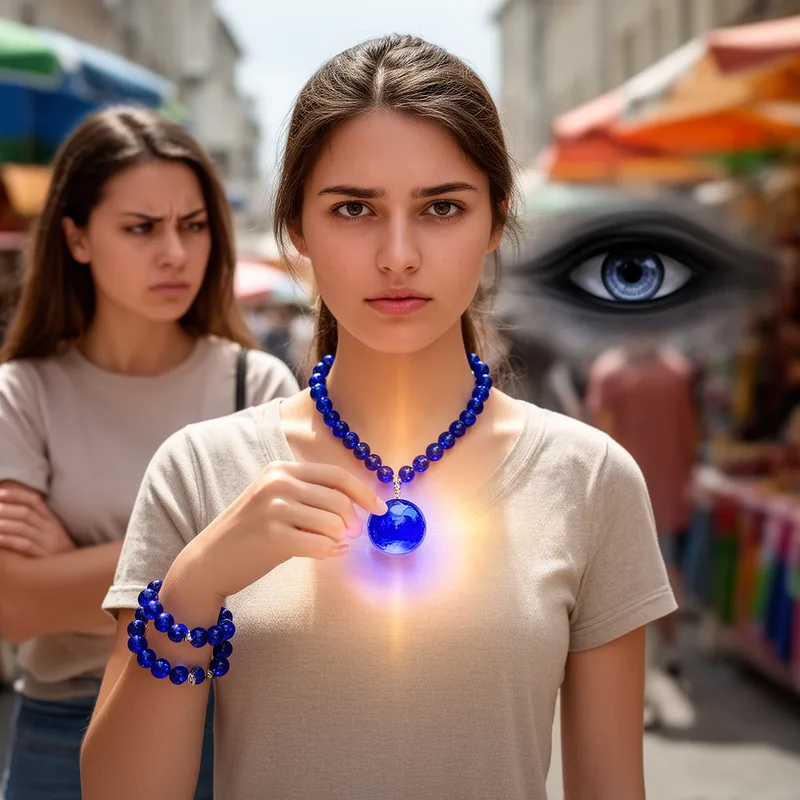
to ward off the evil eye


 1
9.9
1
9.9
- idiom
 :
ahuyentar el mal de ojo
:
ahuyentar el mal de ojo
- You can imagine them trotting with this gesture, which is a gesture to ward off the evil eye in Italian culture.
- signs to ward off the evil eye
Examples
-
Whether to appease a superstitious people or out of sincerely held belief, Pakistani president Asif Ali Zardari sacrifices a black goat nearly every day to ward off the evil eye and provide protection from black magic.
Academic text (2013) -
It, it wards off the evil eye.
-
I should ward off the evil eye making them sit together.
-
"Need to get you a charm or something, maybe a blue bead for your car to ward off the evil eye, you know."
Fiction book (1997) -
Nuala crossed herself, making the sign that wards off the evil eye.
Fiction book (1999) -
When my banjo flashed mother-of-pearl their way, they made the split-finger sign to ward off the evil eye.
Fiction book (1998) -
This implies that the braids are an object of desire and the blue bead is there to ward off the evil eye of those who would covet them.
Academic text (1994) -
Meir tied a red ribbon around the baby's wrist to ward off the evil eye.
-
Some people hang a blue bead in their car to ward off the evil eye and protect themselves from envy.
-
In some cultures, people carry charms to ward off the evil eye during special events.
Synonyms
 34
3.9
34
3.9
Keep unwanted people or things away so they do not harm you
 25
5.0
25
5.0
To turn your eyes or face away to avoid something unpleasant
 2
9.9
2
9.9
To stop danger or harm from happening

To stop something bad from happening
Antonyms

Surface Forms
Morphology
The verb phrase 'ward off' is transparently understood as repelling or protecting, and the constituent words 'evil' + 'eye' give a recognizable hint of a harmful gaze; however 'evil eye' is a culturally specific idiom whose full implicature (misfortune caused by a look and the need for charms/rituals) is not fully predictable from the parts. Because the basic idea can often be inferred—and many languages have an equivalent concept—learners get a partial clue but would likely need exposure to grasp the full cultural/idiomatic sense.
Etymology
The phrase ward off the evil eye comes from old stories that a jealous or angry look—the evil eye—could bring bad luck, so people used charms and signs to ward off that harmful look. So it means 'to protect someone from harm caused by an envious or harmful look'.