
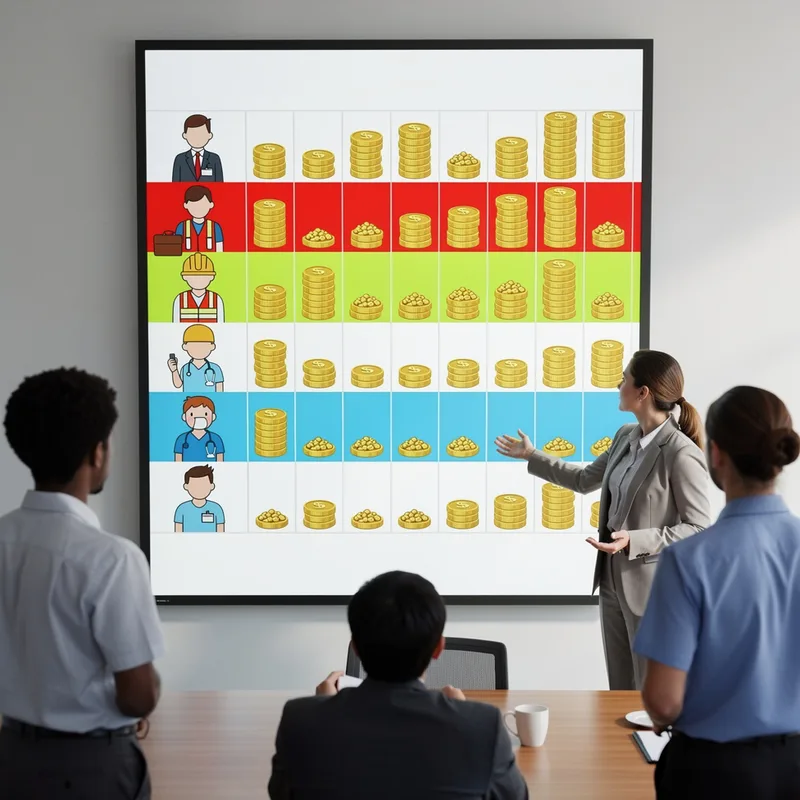
wage scale
 2
3.9
2
3.9

- noun
- /weɪdʒ skeɪl/
- The company implemented a new wage scale to ensure fair compensation for all employees.
- a low wage scale
Examples
-
Some women did receive work relief, but their participation was restricted by quotas, restrictions on the types of jobs, such as sewing, and a wage scale that remained lower than men's wages.
Academic text (1995) -
Each job posting includes the wage scale that applicants can expect based on their experience level.
-
The reduction would be in the form of a $20 billion tax break for businesses and a $10 billion break for workers on the lower end of the wage scale.
Blog text (7) -
We also found a general awareness that tourist-oriented service wages were at the low end of the wage scale.
Academic text (2000) -
Teachers are often paid on a wage scale that emphasizes current efforts rather than mere seniority.
Academic text (1992) -
Overtime laws and the pay-or-play employer mandates of the Affordable Care Act (ACA) — as long as they exist — may increase direct costs much further up the wage scale.
Academic text (2018) -
In the meeting, they discussed how to adjust the wage scale to match market demands.
Synonyms

A list that shows how much employees are paid for each job
How Detailed
2
3.9
 3
3.0
3
3.0
Surface Forms
Morphology
The meaning is directly compositional: 'wage' (pay) combined with 'scale' (a graded system or range) yields 'a graded system of pay rates', which a B1 learner who knows both words can infer. This noun–noun compounding pattern and the idea of a 'scale' of amounts is cross-linguistically common, so the expression is immediately comprehensible from its parts.
Etymology
Wage scale comes from putting together wage (pay) and scale (a row of marks showing levels, like on a ruler or a ladder). Imagine a list of steps where each step shows a different amount of pay; the higher the step, the more money you get, so the phrase now means 'a system that sets different rates of pay'.