
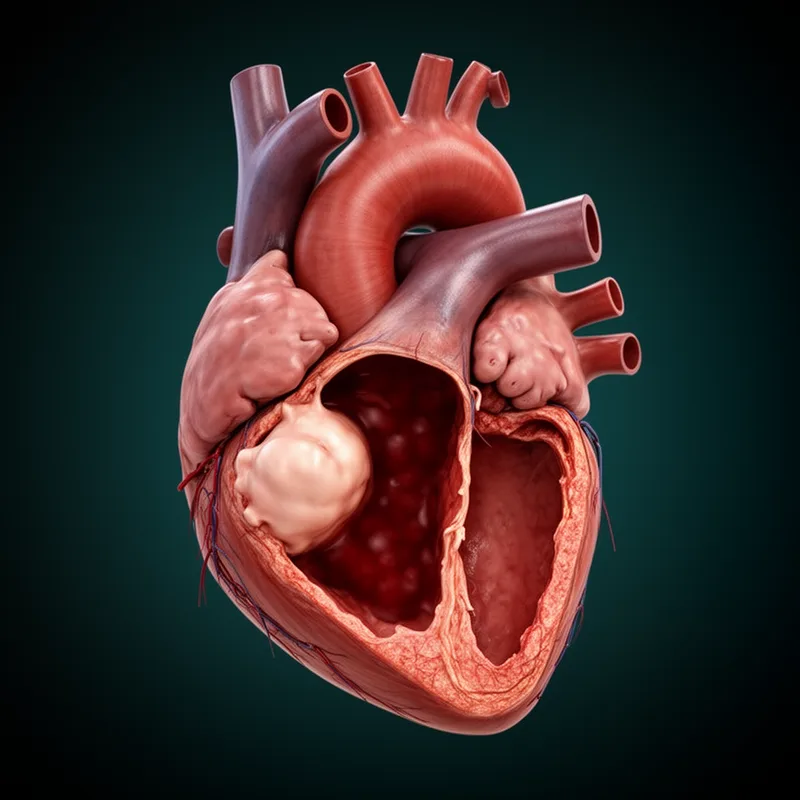
ventricular aneurysm
- noun
- /vɛnˈtrɪkjələr ˈæn.jə.rɪz.əm/
- Specialized
- After his heart attack, the doctor diagnosed him with a ventricular aneurysm indicating a weakness in the heart wall.
Examples
-
The patient was concerned when the echocardiogram revealed a ventricular aneurysm following his recent myocardial infarction.
-
Treatment for the ventricular aneurysm was necessary to prevent further complications after the heart attack.
-
And you suffered a heart attack which caused a ventricular aneurysm.
Surface Forms
Morphology
The term is a straightforward noun phrase combining 'ventricular' (relating to a ventricle) with 'aneurysm' (a bulge or dilation), so its meaning as a bulge/dilation located in a ventricle is directly derivable from the parts. This follows a common anatomical modifier+noun pattern (and parallels constructions in other languages), so a learner who knows both constituents should be able to understand the MWE.
Etymology
Ventricular aneurysm comes from a clear image: the heart's main pumping chamber, the ventricle, develops a weak spot that the word aneurysm names as a balloon-like bulge, often after a heart attack. That's why the term means 'a local bulge in the ventricle' that can make the heart pump poorly or cause irregular beats.

