
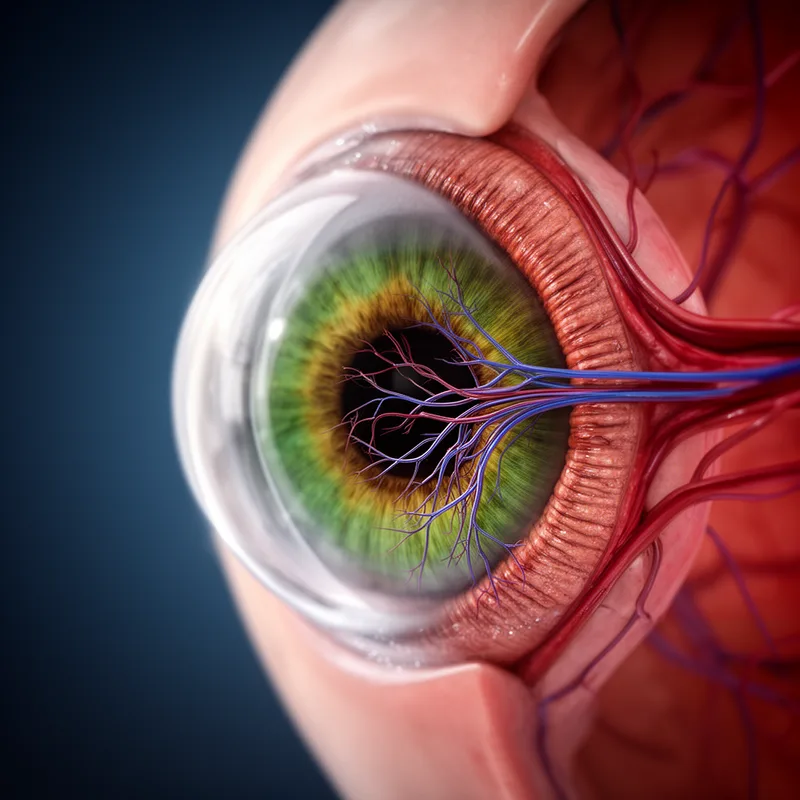
venae ciliares
- noun
- /ˈviːniː ˈsɪliˌɑːriz/
- Specialized
- The venae ciliares play an important role in draining blood from the ciliary body of the eye.
Examples
-
Damage to the venae ciliares can affect intraocular pressure and eye health.
-
Anatomists often refer to the venae ciliares when describing the blood supply around the lens and iris.
-
The venae ciliares play a crucial role in ocular circulation.
-
Inadequate function of the venae ciliares can lead to eye problems.
-
The venae ciliares are essential for maintaining proper blood flow in the eye's ciliary body.
-
Damage to the venae ciliares can lead to complications such as elevated intraocular pressure.
-
Understanding the function of the venae ciliares is important for studying ocular health.
Synonyms

Small veins that drain blood from the part of the eye that controls focus

A small blood vessel at the back of the eye that drains blood to larger vessels
A vein at the back of the eye that drains blood into larger veins of the eye
A vein at the back of the eye that carries blood to larger veins
Surface Forms
Morphology
vena + ciliares
The compound literally joins 'venae' (veins) with a ciliary-related element, so a learner who recognises the medical/Latin root 'cilia' or the adjective 'ciliary' can infer 'veins of the ciliary body'. However, the term is technical and presented in a Latin form ('ciliares' is not an English lemma), so a typical B1 learner who knows only everyday English vocabulary would not reliably derive the exact anatomical sense, making the transparency partial.
Etymology
Venae ciliares comes from Latin: venae means 'veins' and ciliares comes from 'cilia', the word for 'eyelashes' or tiny hairs near the eye. The name gives a simple picture of small veins by the ciliary, eyelash-like part of the eye, so it refers to the small veins that drain blood from the ciliary body.

