
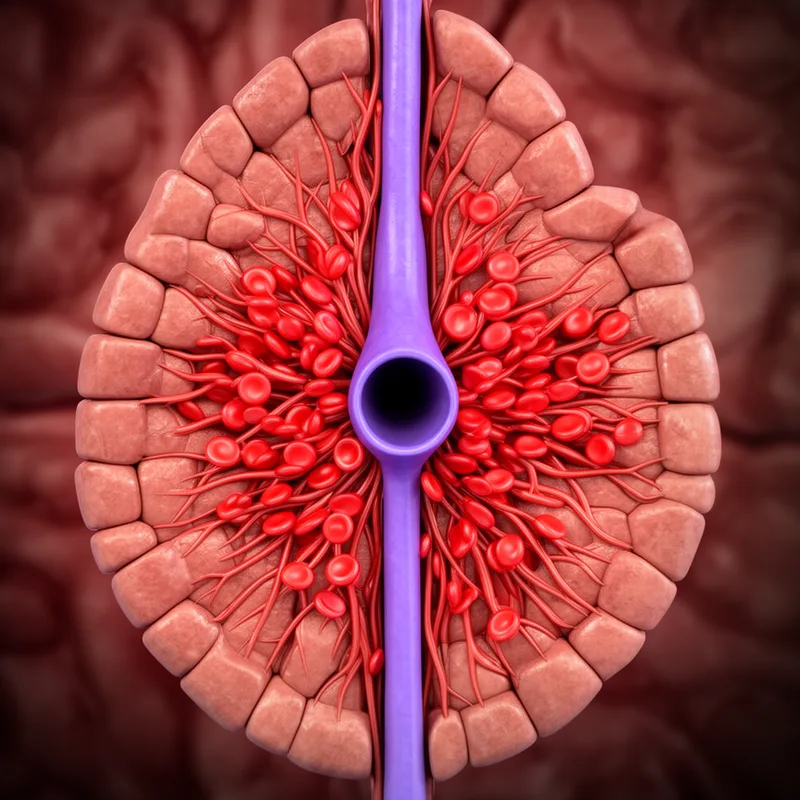
venae centrales hepatis
- noun
- /ˈviːniː ˈsɛntrəlɪz ˈhɛpətɪs/
- Specialized
- The blood collected in the liver sinusoids ultimately drains into the venae centrales hepatis.
Examples
-
Damage to the venae centrales hepatis can impair liver function and blood flow.
-
Microscopic examination revealed blockages in multiple venae centrales hepatis within the sample.
-
The venae centrales hepatis are vital for liver function.
-
What is the role of the venae centrales hepatis?
-
The blood collected in the liver sinusoids ultimately drains into the venae centrales hepatis.
-
Microscopic examination revealed blockages in multiple venae centrales hepatis within the sample.
-
Damage to the venae centrales hepatis can impair liver function and blood flow.
Synonyms
A small blood vessel at the center of a liver lobule that collects blood and sends it to larger veins
Surface Forms
Morphology
vena + centrales + hepatis
This is a Latin anatomical phrase rather than ordinary English composition: only 'vena' corresponds to an English-like lexical item ('vein'), while 'centrales' and 'hepatis' are not English words in the provided data. A B1 learner who knows common English words would not be able to derive the full meaning without specialist/Latin knowledge (though medically trained speakers can map it to 'central veins of the liver'), so it is not transparently compositional for general learners.
Etymology
Venae centrales hepatis literally breaks into venae ('veins'), centrales ('central'), and hepatis ('of the liver'), so it names the small veins in the middle of each liver unit. Imagine the liver as many tiny round rooms with a drain in the center that collects blood and sends it out, and that clear picture explains why the term means the central veins that receive blood.

