

vampire bat
 3
5.1
3
5.1

- noun
- /ˈvæmˌpaɪər bæt/
- Specialized
- In 1995, for instance, workers in Venezuela isolated, from the saliva of the common vampire bat (Desmodus rotundus), an unusual compound that blocks blood clotting in a highly specific way.
- vampire bat (Desmodus rotundus)
Loading YouTube…
Watch on YouTubeAnd they see this all the way down to vampire bats.
- And they see this all the way down to vampire bats.
Examples
-
Although vampire bats are usually a nuisance only to cattle, from which they suck blood, when there's a perceived problem, people generally "go to the cave with the largest number of bats and kill them," Medellin says.
Academic text (1999) -
Vampire bats lick blood but do not suck blood.
Blog text (14) -
Vampire bats drink the blood of animals.
-
People are often unaware of being attacked by a vampire bat while they are sleeping.
-
Vampire bats weigh almost nothing, but they can down a creature nearly ten times their size.
-
Because, contrary to popular belief, bats do not attack people; bats do not tangle in people's hair; and even vampire bats are not true vampires.
Blog text (14) -
Wilkinson's study (1984) on reciprocal feeding in vampire bats is still one of the best examples of reciprocal altruism in animals and hence of the cooperation that also occurs in the absence of close kinship.
Academic text (2008) -
Creatures that drink blood—vampire bats, mosquitoes, and many ticks—have evolved amazingly efficient anticoagulant agents in their saliva to help them feed on their hosts.
Academic text (2004) -
People are often unaware of being attacked by a vampire bat while they are sleeping.
-
At night, you sleep under mosquito netting, which also keeps away vampire bats.
Synonyms
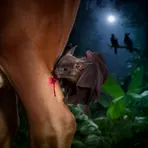
A bat from tropical America that drinks the blood of animals like cows and birds

A family of bats that drink the blood of other animals

A small tropical bat that drinks blood from animals like cows and birds

A group of bats that includes the common vampire bat from Central and South America

A small vampire bat from tropical America that mainly drinks bird blood

A small bat from tropical America that feeds on the blood of birds

A small group of vampire bats from the Americas that includes the hairy-legged vampire bat

A group of vampire bats that drink blood
Surface Forms
Morphology
The compound is a straightforward modifier+head: 'vampire' (blood‑sucking creature) + 'bat' (the flying mammal) yields a bat that feeds on blood. This compositional meaning is immediately inferable from the constituents and follows common noun‑compounding patterns, so a B1 learner who knows both words can understand the MWE.
Etymology
Vampire bat comes from old stories about vampires, who 'drink blood', and the small flying animal, the bat. Because these bats really bite animals at night and feed on their blood, the name shows why we call them that today.