
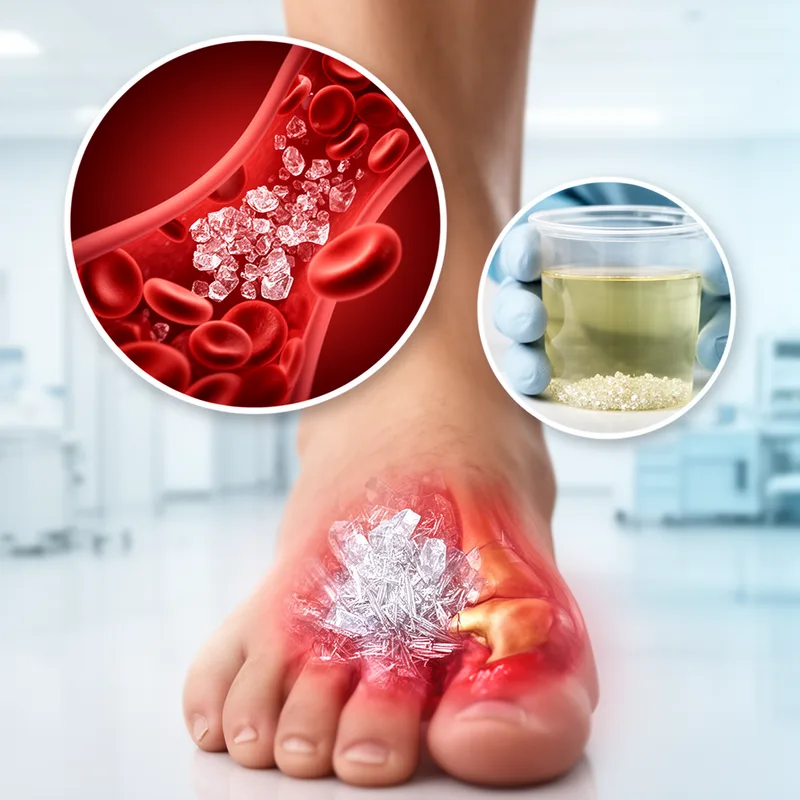
urate
- noun
- /ˈjʊəreɪt/
- Specialized
- To prevent kidney stones, it is important to manage urate levels in the body.
Loading YouTube…
Watch on YouTubeHe also found that lithium urate had a generally calming effect on these Guinea pigs.
- He also found that lithium urate had a generally calming effect on these Guinea pigs.
Examples
-
Our patient had a history of nephrolithiasis, which was later documented to be due to urate excretion.
Academic text (1995) -
Urate levels showed a statistically significant increase during tissue ischemia, but this increase was reduced during reperfusion.
Academic text (1993) -
The only statistically significant difference involved the levels of sweat urate.
Academic text (1993) -
Thus, there was a significant increase in sweat urate in the ischemic phase during wheelchair sitting.
Academic text (1993) -
Sweat urate may well prove to be an important marker in future investigations as an indicator of tissue damage.
Academic text (1993) -
High levels of uric acid raise the possibility of acute urate nephropathy.
Academic text (1995) -
During ischemia, urate production may be increased as a result of degradative loss of high-energy phosphate metabolites (19).
Academic text (1993) -
Results indicated that tissues subjected to pressure ischemia produced a general increase in concentrations of lactate, chloride, urea, and urate associated with a decreased sweat rate.
Academic text (1993) -
The study involving the supine position demonstrated similar increases in chloride, sodium, and urea, but no significant increases in lactate and urate were observed in the ischemic phase.
Academic text (1993) -
High levels of urate in the blood can indicate a risk for conditions like gout.
Surface Forms
Morphology
Etymology
Urate comes from uric, a word linked to urine, and the chemical ending -ate ('a salt', as in sulfate). So urate means a 'salt' of uric acid, which is why it is found in urine and can form crystals in joints that cause gout.

