
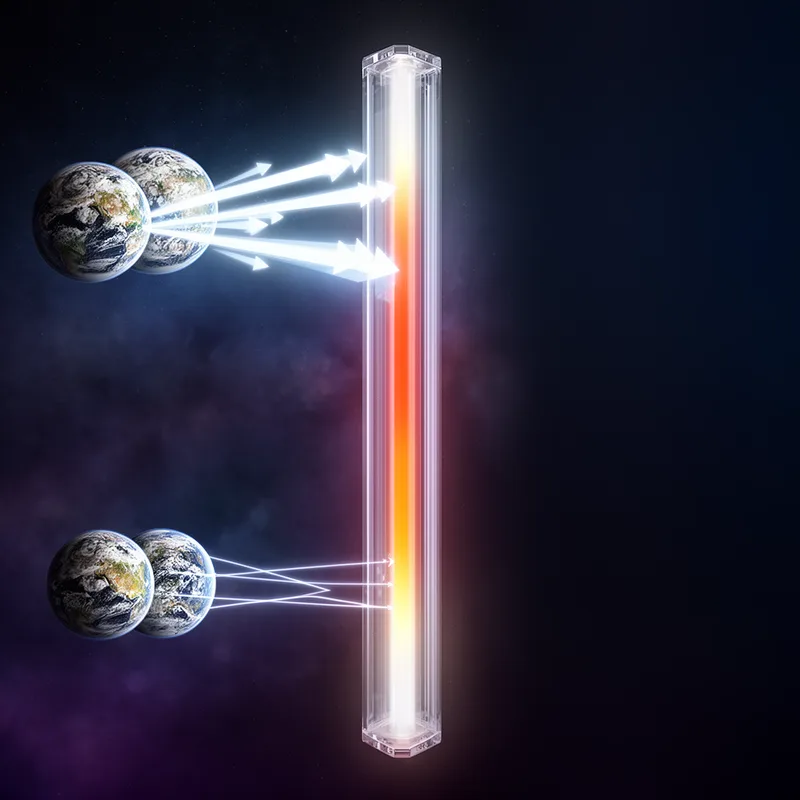
universal gravitational constant
- noun
- /ˌjuːnɪˈvɜːrsl ˌɡrævɪˈteɪʃənl ˈkɒnstənt/
- Specialized
- Newton's law uses the universal gravitational constant to relate mass and distance to gravitational force.
Examples
-
What is the universal gravitational constant?
-
The constant of proportionality universal gravitational constant, denoted by G, is essential for calculating the gravitational force between two objects.
-
Scientists have measured the universal gravitational constant with increasing precision over the years.
-
The value of the universal gravitational constant is essential in calculating the force between two planets.
-
The universal gravitational constant is a key factor in physics.
-
In physics, the universal gravitational constant plays a crucial role in Newton's law of gravitation.
-
To understand how gravity works, one must first learn about the universal gravitational constant, which influences the attraction between masses.
Synonyms

 2
7.5
2
7.5

A number that shows how strong the pull of gravity is between two objects
 1
9.9
1
9.9
A number scientists use to measure the strength of gravity

A number that shows how strong gravity is between two objects depending on their mass and distance
Surface Forms
Morphology
universal + gravitational + constant
The meaning is transparently built from the constituents: 'universal' (applying everywhere), 'gravitational' (relating to gravity), and 'constant' (a fixed value), so together they denote a fixed value used in the law of gravity. This modifier+noun composition follows standard English and has clear equivalents in many languages, so a B1 learner who knows the component words can infer the MWE's meaning.
Etymology
The noun universal gravitational constant comes from the idea of one number that is always the same: universal means used everywhere, gravitational means about gravity, and constant means 'always the same'. Imagine this single 'constant' turning mass and distance into the 'pull' between two objects, so scientists use it to work out how strong gravity is.