
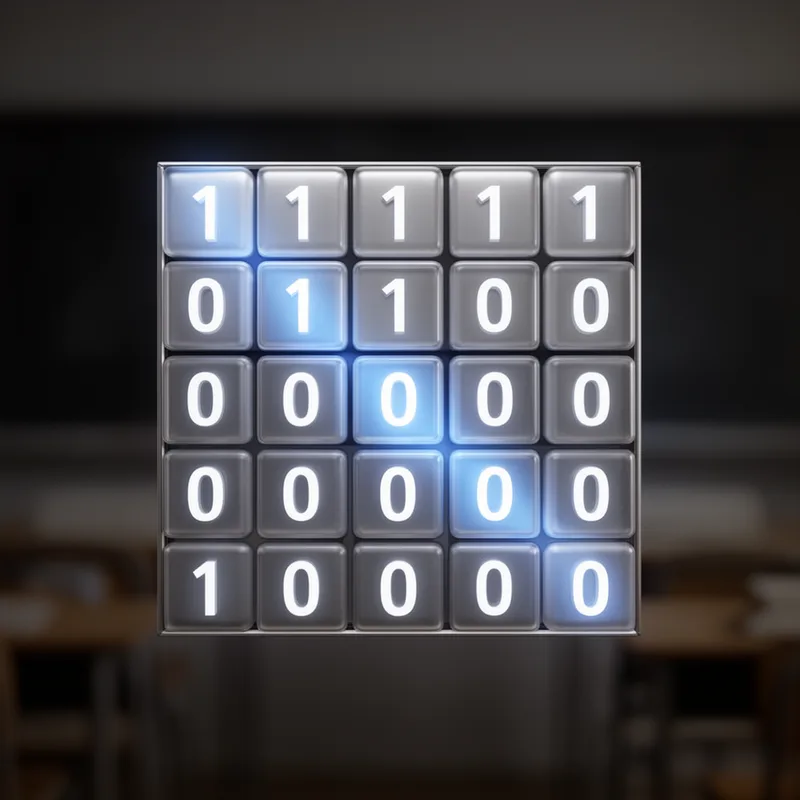
unit matrix
- noun
- /ˈjunɪt ˈmeɪtrɪks/
- Specialized
- When performing matrix multiplication, multiplying any matrix by the unit matrix yields the original matrix.
Examples
-
With N as the noise power, 1 as the unit matrix, Tr as the trace, and det as the determinant.
Academic text (2001) -
If we start with the unit matrix, in how many distinct directions in the group space can we deform away from the identity?
-
If I were to make this plus one, it would just be the good old unit matrix, but it's not.
-
You sum over space and keep the labels, and you get sort of a unit matrix in this space, in the space of labels.
-
You haven't done really much, but you've rewritten the Hamiltonian with a unit matrix here, perhaps in a somewhat provocative way.
-
In linear algebra, the unit matrix is often denoted by I and is crucial for solving systems of equations.
-
To calculate the inverse of a matrix, you first need to ensure that it is not equal to the unit matrix.
Synonyms

A square table of numbers with ones on the diagonal and zeros elsewhere that acts like one when multiplying matrices
Surface Forms
Morphology
The noun combination gives a clear clue—'unit' (one/single) modifying 'matrix' (array of numbers) makes it plausible to infer a matrix related to ones—so part of the meaning is derivable from the constituents. However, the precise convention (ones on the principal diagonal and zeros elsewhere) is a specialized mathematical convention that is not fully predictable from the basic word senses alone, so some prior exposure is needed.
Etymology
Unit matrix comes from the idea of a 'unit' meaning the number one placed along the main diagonal (from top left to bottom right) of a square matrix. The row of 1s with zeros everywhere else acts like the number '1' in multiplication, so multiplying by a unit matrix leaves any matrix unchanged.

