
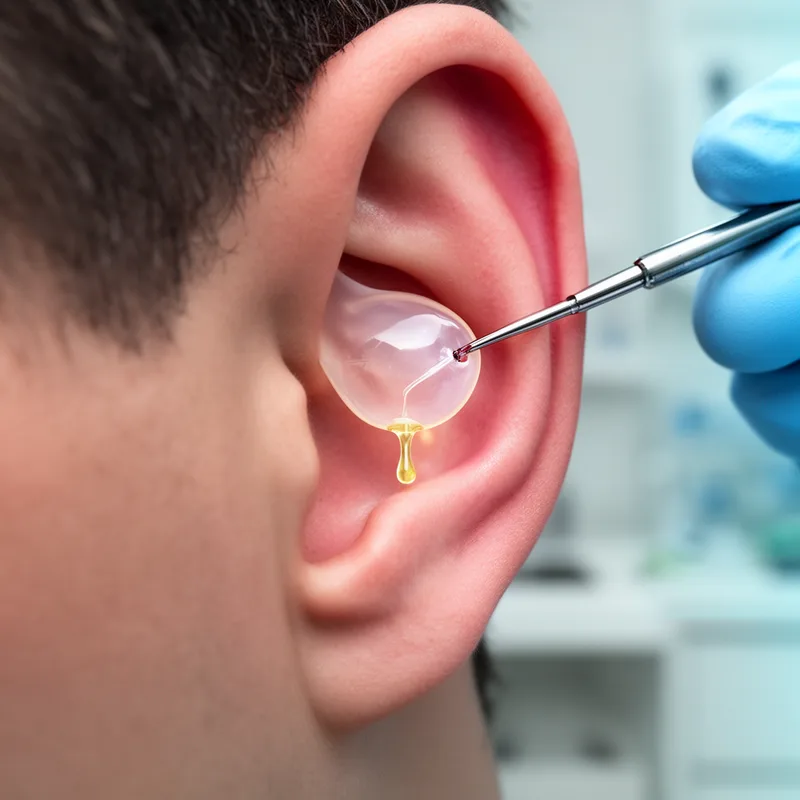
tympanotomy
- noun
- /ˌtɪmpəˈnɑːtəmi/
- Specialized
- During the tympanotomy, an incision was made in the eardrum to allow for proper healing.
- posterior tympanotomy
Examples
-
In cases of acute unilateral deafness, no consensus exists as to whether tympanotomy and sealing of the round window should be performed routinely.
Academic text (2008) -
The middle ear cavity medial to the tympanic membrane was exposed through a posterior tympanotomy.
Academic text (1995) -
This was done before and after tympanotomy with LED and photocell in the same position.
Academic text (1995) -
In order to prevent trauma to the inner ear, the incudostapedial joint needed to be separated through a posterior tympanotomy prior to the removal of the incus.
Academic text (2005) -
We have used bone pate to supplement fixation of the lead wire at the region of the posterior tympanotomy to keep it from slipping out, which is among the most frustrating problems in cochlear implant surgery.
Academic text (1998) -
Instead, a transmastoid transfacial recess (posterior tympanotomy) approach was used to separate the incudostapedial joint with an argon laser prior to incus removal.
Academic text (2005) -
The surgeon performed a tympanotomy to drain fluid from the patient's middle ear.
-
After the tympanotomy, the patient felt immediate relief from the pressure in their ear.
Synonyms


 1
9.9
A small cut in the eardrum to drain fluid and ease pressure in the middle ear
 1
9.2
A small operation that makes a hole in the eardrum to let fluid out and make pressure equal
How Invasive
- Specialized
1
8.9

- Specialized
1
9.9
- Specialized
- Specialized
4
4.8
Surface Forms
Morphology
Etymology
Tympanotomy comes from Greek parts tympan- meaning 'drum' and -tomy meaning 'cutting', the same -tomy you see in appendectomy. So a tympanotomy literally means 'cutting the drum', which explains why it is a small surgical cut in the eardrum to let fluid out or relieve pressure.