

to turn red
 18
1.2
18
1.2

- phrasal verb
- /tɜrn rɛd/
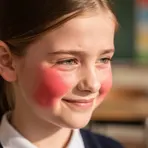
- My cheeks turn red, but I try to appear nonchalant.
- turn red face
- turn red skin
- turn red cheeks
Loading YouTube…
Watch on YouTubeMy cheeks turn red, but I try to appear nonchalant.
- My cheeks turn red, but I try to appear nonchalant.
- When we feel embarrassed, we turn red, right?
- And whenever I would talk in public, you would turn, turn red.
- And I'd get mad and, and chew them out and my ears would turn red.
- You know, when he talks about, for example, a person who feels fear turning white, a person who feels shame turning red.
- But here's the thing, whenever I do really high activity things, for whatever reason, my face turns red.
Examples
-
Look at me, I'm turning red.
-
She went silent, turned red and ran out of the room.
-
When you get upset, when you get mad, you turn red, right?
-
But when he looked away from me and his face turned red, I knew the truth.
Fiction book (1995) -
I can feel my face turn red and my eyes water.
Fiction book (1993) -
Surely you should have asked first?" Coren suddenly looked quite sheepish and turned red in the face.
Fiction book (1995) -
Patti scrubs the sides of the grimy boards, her face turning red from the effort.
Fiction book (1994) -
Josh's freckled face turned red, right to the roots of his reddish-blond hair.
Fiction book (1993) -
The short, balding 45-year-old commander's face turned red as he ordered Emilio confined to his room.
Fiction book (1996) -
When he complimented her, she turned red and looked away shyly.
Synonyms
 99
1.3
99
1.3
To become red in the face from embarrassment or cold
 80
3.4
80
3.4
To become red because of heat or strong feeling
 11
3.7
11
3.7
To change to red, for example from heat or embarrassment

To become red in the face when you feel embarrassed

To become red in the face from embarrassment or shame
Antonyms

How Red
18
1.2
 99
1.3
99
1.3
Surface Forms
Morphology
The meaning 'to become visibly red' is directly and transparently derived from combining 'turn' (change) with 'red' (the colour), so a learner who knows both words will infer 'change to red'—typically of the face in context. This change-of-state verb + adjective pattern is common in English and cross-linguistically, making the expression immediately comprehensible to B1 learners.
Etymology
Turn red comes from the simple image of a face actually turning red when blood rushes into the cheeks. This often happens with 'embarrassment', 'shame', or anger, so the phrase now means 'to become visibly red in the face' as a sign of those feelings.