

turbofan engine


 1
5.1
1
5.1
- noun
- /ˈtɜrbəˌfæn ˈɛnʤɪn/
- Specialized
- The turbofan engine design significantly reduces noise pollution compared to older jet engine models.
- bypass turbofan engines
- fan in turbofan engines
- high bypass turbofan engine
Examples
-
These existing commercial aviation turbofan engines had bypass ratios between 1:1 and 1:2.
Academic text (2011) -
Many new military jets are equipped with advanced turbofan engines that enhance their speed and maneuverability.
-
Aircraft of almost every kind have been powered by turbofan engines.
Academic text (2003) -
The development of the fuel-efficient turbofan engine was foretold 30 years before it became a reality.
Academic text (2003) -
That's why a new turbofan engine system being developed by a small start-up company in Connecticut is generating some excitement.
Academic text (2009) -
Today, about 48,000 turbofan engines power Western military and civilian aircraft into subsonic and supersonic flight.
Academic text (2003) -
In contrast, a typical turbofan engine uses a fan to compress most of the incoming air by only a small amount, about twice the inlet pressure.
Academic text (2003) -
Attaining the desired fuel efficiency for the high bypass turbofan engine meant doubling the compressor pressure ratio from 12 to 24.
Academic text (2003) -
Pratt & Whitney's recent introduction of its new geared turbofan engine is an example of the primacy of engine technology in aviation. P&W has been developing this new engine, the PW1000G, since the 1980s.
Academic text (2012) -
Modern turbofan engines are known for their ability to provide efficient thrust in commercial airliners.
Synonyms
 14
3.7
14
3.7
An engine that pushes a plane by shooting out fast hot air
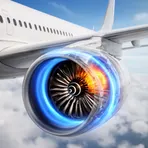 1
6.1
1
6.1
A jet engine with a big fan that gives extra power and saves fuel on passenger planes
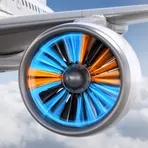
A jet engine with a large front fan that pushes extra air to make more power and save fuel

A jet engine with a large front fan, or a plane powered by it

An engine with a large fan that pushes extra air to make the plane go faster

A machine that pushes a rocket or other spacecraft forward by shooting out fast gases
How Powerful
- Specialized
1
5.7

- Specialized
1
5.1
- Specialized
3
6.9
- US
Surface Forms
Morphology
The meaning 'a type of jet engine...' is directly and transparently derived from combining 'turbofan' (a fan-driven turbine concept) with 'engine' (a machine that produces mechanical power); the phrase simply names a kind of engine. This is a literal noun + noun classificatory pattern found across languages, so a B1 learner who knows both constituents would readily infer the MWE meaning.
Etymology
Turbofan engine comes from the two parts you can picture: a fan at the front and a turbine, a wheel inside that turns. The big fan pushes extra air to give more 'push' and to save fuel, so the name helps you remember that this engine makes more power and uses less fuel.