

turbinate
- noun
- /ˈtɜːrbɪneɪt/
- Specialized
- The patient underwent partial reduction of the turbinates to relieve nasal obstruction.
- inferior turbinate
- middle turbinate
- superior turbinate
Loading YouTube…
Watch on YouTubeYou trim the turbinates, is that correct?
- You trim the turbinates, is that correct?
- We have to force it through this gauntlet of turbinates and mucosa and cilia and all of these different structures.
Examples
-
Functionally, the inferior turbinate primarily serves to contribute to the humidification and warming of inspired air.
Academic text (2003) -
Partial resection of the bulky portion of the middle turbinate is important for a number of reasons.
Academic text (1994) -
Under direct vision, he identified a superior turbinate in 67 specimens.
Academic text (2008) -
In addition, one case report of unilateral inferior turbinate mucocele has been published.
Academic text (2003) -
We also observed hypoplasia of the right inferior turbinate that corresponded with the location of the foreign body.
Academic text (2008) -
The inferior turbinate helps to filter and humidify the air we breathe before it reaches the lungs.
-
During the surgery, the doctor examined the condition of the right turbinate to address the patient's nasal issues.
-
The structure of the nasal cavity includes the turbinate bones, which play a crucial role in respiratory health.
Synonyms

A thin curved bone inside the nose that helps filter and moisten air
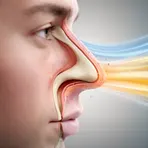
A thin curved bone inside the nose that helps warm, moisten and filter air
Compounds
Surface Forms
Morphology
turbinate = turbine (opaque) = turbin + ate
The noun sense names the nasal bones after their whorl-like shape, but the morphological elements ('turbin-' + '-ate') are Latin-derived and not transparently meaningful to an average learner.
Etymology
The turbinate bone is named from Latin turbo 'whirl' since these bones curl like small spirals inside the nose. They are called turbinates because their spiral shape helps warm, clean, and moisten the air we breathe.

