

tunnage
- noun
- /ˈtʌnɪdʒ/
- Archaic
- The government introduced a new law that revived the historical tax known as tunnage, charging ships based on their tonnage.
- tunnage and poundage
Examples
-
When the Parliament reassembled in 1629, Charles failed to persuade the Commons to put the customs duties known as Tunnage and Poundage on a statutory footing.
Academic text (2011) -
The hollowness of the Commons' triumph was soon exposed, for in 1629, despite its vigorous protests, the Commons was unable to prevent the king from continuing to levy Tunnage and Poundage without parliamentary authority.
Academic text (2011) -
Finally, in 1629, the Commons refused to give priority to the Tunnage and Poundage bill because their attention was then focused on matters of religion.
Academic text (2011) -
Its power, such as it was, consisted of an ability to deny the king those things that he wanted to obtain, such as the Union, subsidies, or a formal grant of Tunnage and Poundage.
Academic text (2011) -
In the 17th century, merchants were often burdened by tunnage, which added extra costs to their shipping enterprises.
-
To enter the harbor, ships must pay a fee based on their size, referred to as tunnage.
Synonyms

 1
7.0
1
7.0

A tax charged to ships entering a country based on their size
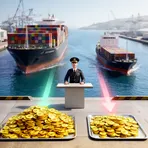
A tax charged on ships entering a country based on how much the ship can carry
Surface Forms
Morphology
Etymology
Tunnage comes from the old word tun, which meant a 'large barrel' for wine, and ports used to charge a fee for each tun a ship carried. Over time that idea moved to tonnage (and the word ton as a measure of size), so tunnage came to mean a 'tax' or charge based on a ship's size.