
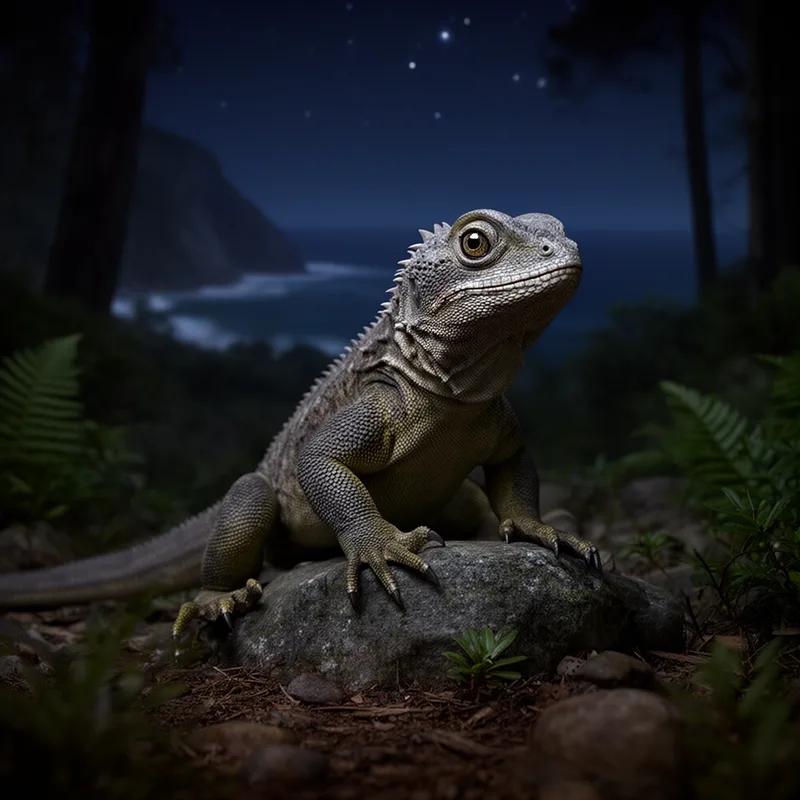
tuatara
 1
9.9

- noun
- /ˈtwäˌtärə/
- New Zealand
- Rhynchocephalians (beakheads) form the sister group to the squamates (lizards and snakes) and are represented by the extant single genus Sphenodon (the tuataras) today.
- tuatara lizard
- tuatara are considered
- tuatara on some islands
Examples
-
Some species (for example, the tuatara) are both uncommon and rare, but many evolutionary relicts with few close relatives—for example, the horseshoe crab—are relatively common.
Academic text (1998) -
It houses extremely rare types like Indian rhinos, ring-tailed mongooses, and tuataras.
Blog text (34) -
Skull of a tuatara (a), a member of the order Rhynchocephalia, is relatively rigid.
Academic text (2006) -
That group was widespread and diverse before the end of the Middle Triassic, but only two descendants have survived to the present: they are the two species of tuataras that occur in New Zealand.
Academic text (2006) -
However, fossils show that these supposed island specialties were formerly abundant on the mainland, as were tuataras (now confined to islands) and colonies of breeding seabirds (now largely just on islands).
Academic text (1990) -
In contrast, all of the approximately 250 species of turtles, 21 species of crocodilians, and 2 species of tuatara are oviparous, producing only shelled eggs (Blackburn 1982, 1985; Shine 1985).
Academic text (1993) -
The tuatara is a rare reptile that can only be found in New Zealand.
-
At night, the tuatara comes out to hunt for insects and other small prey.
-
Conservation efforts have helped the tuatara population slowly recover over the years.
Synonyms

 1
9.9
A reptile like a lizard living only in New Zealand and the last of an ancient group
A New Zealand reptile that looks like a lizard but is the only living member of an ancient group
Surface Forms
Etymology
Tuatara comes from Māori and originally meant something like 'spines on the back', from the parts tuā 'back' and tara 'spike'. That's why the reptile's name points to the row of small spines or crest along its back.