

tsunami
 87
4.9
87
4.9

- noun
- /tsuˈnɑːmi/
- The earthquake and resultant tsunami collapsed facilities and damaged infrastructure in a huge swath of northeast Japan.
- a tsunami warning
- tsunami waves
- tsunami after an earthquake
Loading YouTube…
Watch on YouTubeThis forum will examine the response to the earthquake, tsunami, and nuclear crises in Japan.
- This forum will examine the response to the earthquake, tsunami, and nuclear crises in Japan.
- Well, the tsunami isn't going to affect us here.
- The big Christmas Day suit or Boxing Day tsunami in Thailand, was it in East Asia?
- But by doing that, these plants then can be susceptible to to tsunamis crashing into them.
- You said that there's tsunami seasons, and I said, what do you think a tsunami is?
- And one of the reasons it's hard is you cannot easily untangle the tsunami from the nuclear reactor accident.
- That was a tidal wave, rocky right angles, tsunamis.
- Dude, a freak tsunami at a wave pool in China.
- And that's why they should to build a giant ass wave pool where every giant tsunami wave is the same.
Examples
-
The earthquake happened, but the real disaster was the tsunami that followed, as we all know.
-
It is the most devastating tsunami in recorded history.
-
All the animals started running up into the hills because they could sense that tsunami was coming.
-
Thousands upon thousands dead in that tsunami.
-
Japan has one of the most advanced tsunami warning and preparation systems in the world.
Academic text (2005) -
We do have information that the tsunami has made landfall.
-
There's a tsunami warning for the next two hours.
-
Reports of the death toll kept increasing soon after the tsunami occurred on December 26, 2004.
Academic text (2005) -
After the 2004 Asian tsunami, one million people were initially displaced in Sri Lanka.
Academic text (2012) -
After the earthquake, a massive tsunami struck the coastal town, leaving destruction in its wake.
Synonyms
 7
3.2
7
3.2
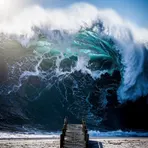
A very large wave of water that suddenly rises along the coast and causes damage
Antonyms


Compounds


How Big

Surface Forms
Etymology
Tsunami comes from Japanese parts tsu and nami, which mean 'harbour' and 'wave', so the word literally means a 'harbour wave'. That's a helpful way to remember that a tsunami is a very large sea wave that can hit the coast after an underwater earthquake.