

true vocal fold
- noun
- /tru ˈvoʊkəl foʊld/
- Specialized
- During the voice lesson, the instructor clarified the importance of the true vocal folds in producing sound.
Examples
-
The saccule, which is the anterior-most part of the laryngeal ventricle, lies between the false and true vocal folds.
Academic text (2009) -
Postoperatively, the patient experienced transient weakness of the left true vocal fold.
Academic text (2005) -
The true vocal folds are rarely affected.
Academic text (2003) -
The true vocal folds and their motility were not affected clinically.
Academic text (2004) -
Multiple oncocytic cysts and noncystic oncocytomas of the true vocal folds have been previously documented.
Academic text (2009) -
However, a few cases of oncocytic cysts have been reported arising from the true vocal folds, even though they are devoid of glandular structures.
Academic text (2009) -
Abduction and adduction of the vocal folds were normal; however, the view of the right true vocal fold was partially obstructed by the lesion.
Academic text (2005) -
Repeat fiberoptic nasolaryngoscopy showed bilateral mobility of the true vocal folds and no obvious laryngeal mucosal tears.
Academic text (2005) -
Magnetic resonance imaging (MRI) revealed the presence of a lesion that extended from the level of the left aryepiglottic fold to the true vocal fold (Figure 1).
Academic text (2005) -
The doctor examined the true vocal folds to ensure they were functioning properly.
Synonyms

 35
3.5
35
3.5

A fold in the throat that vibrates to make your voice


 1
5.6
1
5.6
A thin piece of tissue in the throat that vibrates to make the voice
 1
6.3
1
6.3
A thin piece of tissue in the throat that vibrates to make sound

A lower fold of tissue in the throat that makes sound when air passes between the two

Lower band of tissue in the throat that makes sound when air passes between the two bands

A fold of soft tissue in the voice box that makes sound when air passes through
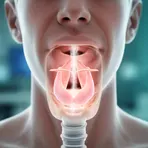
Thin folds of tissue in the throat that make sound when you speak
Surface Forms
Morphology
The components 'vocal' (voice-producing) and 'fold' (a fold of tissue) transparently point to a fold involved in voice production, so part of the meaning is recoverable from the constituents. However, the precise anatomical sense — the specific ligamentous folds that vibrate to produce sound and the nuance signalled by 'true' (as opposed to the 'false' vocal folds) — is technical and not fully predictable for a B1 learner, so it is only partly transparent.
Etymology
The noun true vocal fold refers to the lower pair of thin bands inside the 'voice box' that actually vibrate when we speak or sing. Because these vocal folds really 'make sound', they are called true to show they are the real voice makers.