
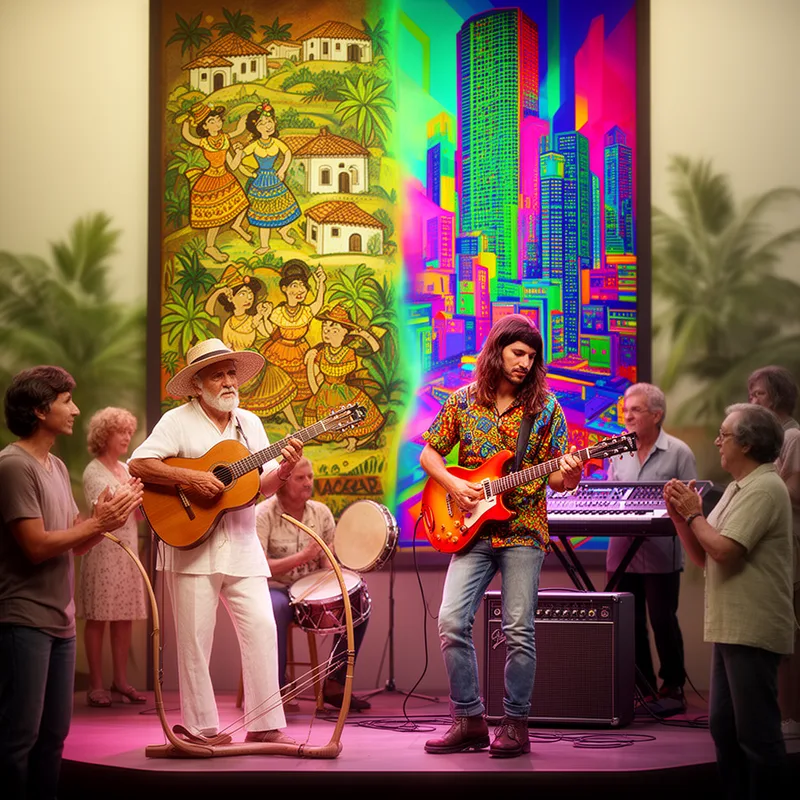
tropicalismo


 1
9.6
- noun
- /trɒpɪkəˈlɪzmoʊ/
- Cut-and-dried lines between "national" and "alienated" music were blurred by Tropicalismo, a brief movement with enduring effects.
- heir to tropicalismo
- Tropicalismo in the canon
- Brazilian tropicalismo
Examples
-
At that time, Tropicalismo rejected the musical purism of protest music and adopted the television spectacle as its medium.
Academic text (2000) -
Musicians who embraced Tropicalismo transformed Brazilian music by incorporating international styles and sounds.
-
As identity discourse, Tropicalismo has been used as a kind of stable reference for understanding the present.
Academic text (2000) -
Caetano's book is intended to secure the place of Tropicalismo in Brazilian culture.
Academic text (2000) -
Tropicalismo captured a band of followers in a generation that now wonders, "Who are we now?"
Academic text (2000) -
From the perspective of the present, Vasconcellos seems to think that Tropicalismo is part of what has gone wrong in Brazil.
Academic text (2000) -
The last point is essential: Tropicalismo's place in the canon is now guaranteed by its wide audience.
Academic text (2000) -
For the book's detractors, what is at stake is how Tropicalismo may be a signpost to what went wrong.
Academic text (2000) -
Who, then, are Tropicalismo's legitimate heirs today?
Academic text (2000) -
Inevitably, consensus has both caused and had the effect of blunting the critical edge of Tropicalismo's views on contemporary cultural politics.
Academic text (2000)
Synonyms
An artistic movement in Brazil in the late 1960s mixing local and international styles
Surface Forms
Etymology
Tropicalismo comes from tropical ('of the tropics') and the ending -ismo (like the English '-ism', which names a movement or style). It was used in Brazil for a 1960s art and music movement that mixed local tropical culture with modern international ideas, so the name points to a 'tropical' artistic style.