
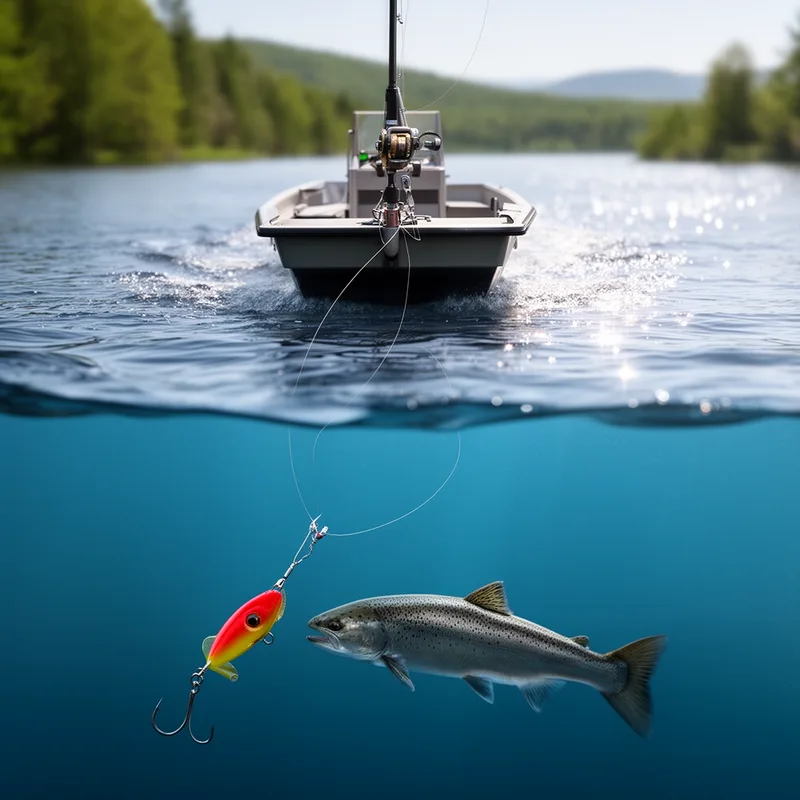
trolling line
- noun
- /ˈtroʊlɪŋ laɪn/
- The fisherman set up a trolling line early in the morning.
Examples
-
The fisherman let out the trolling line as the boat picked up speed across the lake.
-
After hours without a bite, they finally caught a salmon on the trolling line.
-
She adjusted the depth of her trolling line to target larger fish near the surface.
-
We used a trolling line to catch salmon last weekend.
-
The fisherman secured the bait to the end of the trolling line before casting it into the water.
-
As the boat moved slowly, the trolling line sank beneath the waves, hoping to attract more fish.
-
Using a trolling line allows anglers to cover more water and increase their chances of catching larger fish.
Synonyms

 11
2.0
11
2.0

A strong thin string used to catch fish with a hook

A strong thin cord used to catch fish with a fishing rod
Surface Forms
Morphology
The noun is transparently built from 'troll' (to fish by towing a baited line) plus 'line' (a long thin cord), so its meaning — a line used for trolling — is directly compositional. This verb+noun formation is a regular, cross-linguistically common pattern, and any potential ambiguity from the modern 'internet troll' sense is resolved by the fishing context, so a B1 learner knowing both constituents would grasp the meaning.
Etymology
The noun trolling line comes from a simple fishing method where a line with bait is trailed behind a moving boat and the action is called trolling because the bait moves through the water like a small fish and attracts bigger fish. So a trolling line is the line you let out behind a boat to 'catch fish'.