
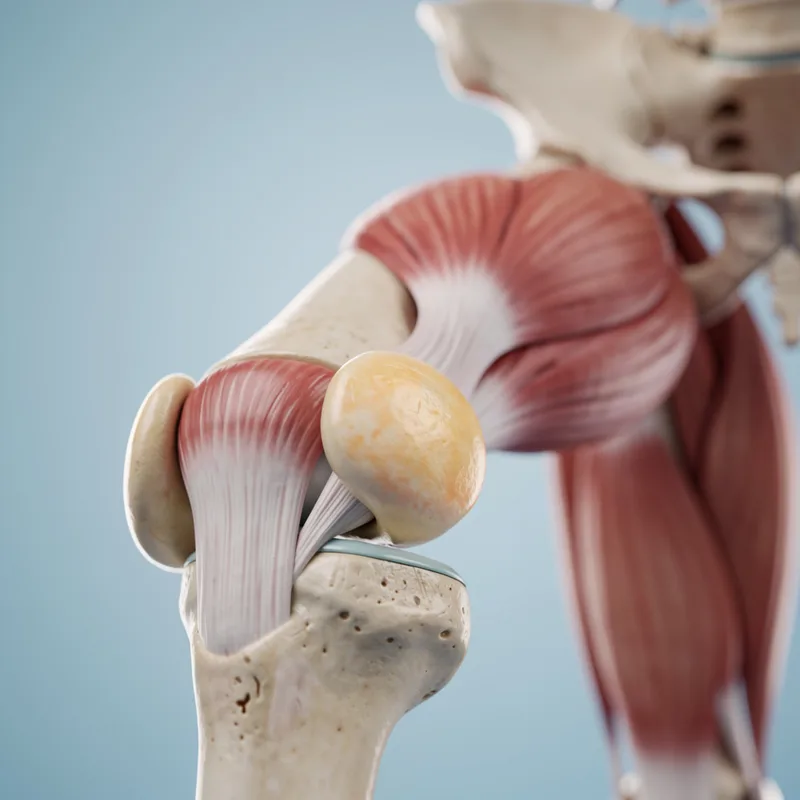
trochanter
 1
9.9
1
9.9

- noun
- /troʊˈkæntər/
- Specialized
 :
trocánter
:
trocánter
- During the surgery, the surgeon carefully examined the greater trochanter for any signs of damage.
- the greater trochanter
- femoral trochanter
Examples
-
They can also occur at the iliac crest and at the lesser trochanter of the femur (iliopsoas attachment).
Academic text (2006) -
The ischium (24 percent), sacrum (23 percent), trochanter (15 percent), heel (8 percent), and scapula (5 percent) are the most common sites for these ulcers (2).
Academic text (1999) -
Greater trochanter - posterior to trochanteric prominence
Academic text (2003) -
The accuracy rate ranged from as little as 63% for the distance between the point on the femoral head and the greater trochanter to 85% for the distance between the greater and lesser trochanters.
Academic text (2007) -
Hip angle was defined by the markers placed on the seventh cervical vertebra and the greater trochanter, and a horizontal line drawn from the greater trochanter.
Academic text (1996) -
Measurements were obtained for the total hip and for four subregions (i.e., femoral neck, trochanter, Ward's triangle, and intertrochanter).
Academic text (2004) -
A common clinical indicator used in skin assessment of the load-bearing surfaces of wheelchair users (buttocks, greater trochanter, sacrum, etc.) is erythema or skin redness (7).
Academic text (1991) -
The greater trochanter serves as the attachment point for several important muscles in the leg.
-
Anatomy students often learn how to locate the trochanter on the femur to understand muscle attachments.
Surface Forms
Etymology
Trochanter comes from an old Greek root troch- that carries the idea of 'run' or 'runner'. A helpful way to remember it is that the trochanter is a bony knob on the upper thigh bone where muscles attach to help you move your leg, as when you walk or run.