
trichotillomania
 1
9.9

- noun
- /ˌtrɪkəˌtɪləˈmeɪniə/
- Specialized
- Persons with trichotillomania typically pull from the scalp, but hair pulling from eyelashes and brows, pubic areas, the face, extremities, and other parts of the body has also been reported (Christenson, Mackenzie et al.).
- criteria for trichotillomania
Examples
-
The second was to examine the use of a numbing cream as an adjunct treatment for trichotillomania.
Academic text (2008) -
Trichotillomania appears to be more common in women than men, with some studies indicating female to male sex ratios as high as 10:1 (Christenson & Mansueto, 1999).
Academic text (2006) -
Sixteen hair care professionals reported having clients who were believed to meet general criteria for trichotillomania.
Academic text (2006) -
This study gave a preliminary indication of the existence of trichotillomania in African Americans.
Academic text (2006) -
I also have trichotillomania or compulsive hair-pulling.
Blog text (32) -
One is trichotillomania, which is basically a compulsive pulling out of hairs.
Blog text (32) -
Of the entire sample, 2% responded consistent with DSM-IV-TR criteria for a diagnosis of trichotillomania.
Academic text (2006) -
Of the current sample, 0.3% met the full DSM-IV-TR diagnostic criteria for trichotillomania.
Academic text (2006) -
People with trichotillomania may also pull hair from family members, friends, pets, or dolls, possibly due to an interest in fibers or a desire to handle objects and receive stimulation on the fingertips (Christenson & Mansueto, 1999).
Academic text (2006) -
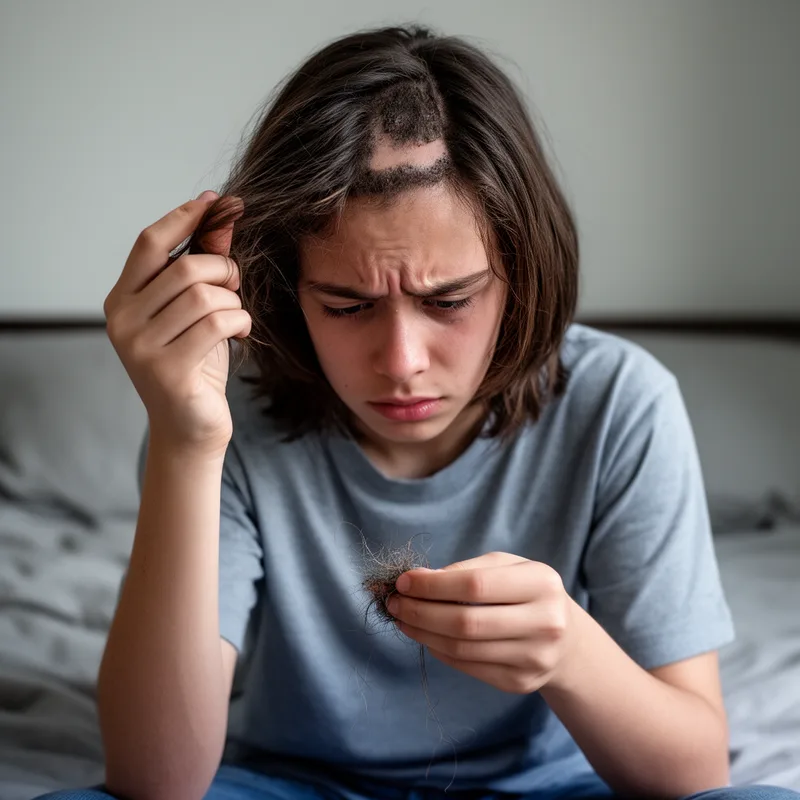
Trichotillomania is often characterized by a strong urge to pull out one's own hair.
Surface Forms
Morphology
trichotillomania = tricho + tillo + mania
The word is formed from Greek combining forms (tricho- 'hair', tillo- 'pull') plus the suffix -mania; these combining forms are not productive or recognizable to an average B1 learner (only '-mania' may be partly recognized), so the meaning is not reliably derivable from familiar English base words.
Etymology
The word trichotillomania comes from Greek parts: tricho- 'hair', -tillo- 'to pull', and -mania 'madness'. So, it literally means 'hair-pulling madness', which explains the strong urge to pull out one's own hair.