
trecento


 1
9.9
- noun
- /trɛˈtʃɛntoʊ/
- Formal
- The trecento, the early period illustrated by Giotto, was "tinged with Christian color," and mysticism flourished (231).
- trecento painting
- trecento church
- trecento in Florence
Examples
-
Virtually all of the important trecento churches of Florence participated in this development, which continued unabated in the following century.
Academic text (2015) -
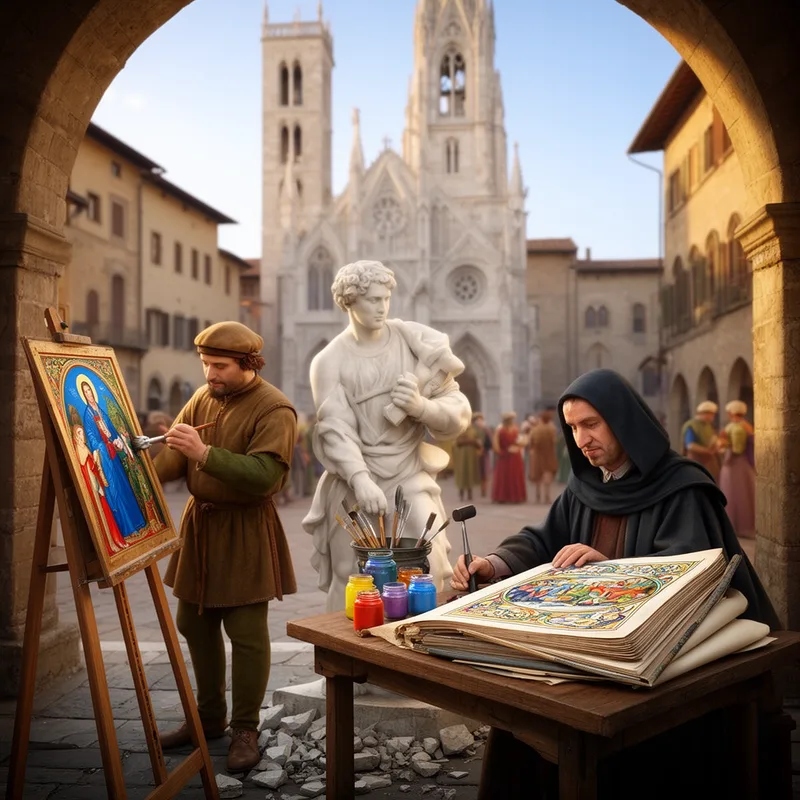
The trecento was a remarkable period in Italy known for its unique contributions to art and literature.
-
Nor was it simply another stage in an evolutionary continuum of trecento practice that was extended into the early Renaissance.
Academic text (2015) -
Especially, the drawing after Giotto does little to amend the clearly trecento pose of its model.
Academic text (2011) -
On close inspection of the plan, the critical relation of the new S. Lorenzo to its trecento milieu becomes apparent.
Academic text (2015) -
Two such periods were the Italian Renaissance (by which was meant the trecento and quattrocento) and the French Renaissance minus its church construction.
Academic text (1998) -
Added to the old nave, which was intended to remain standing, it would follow the T-shaped typology of the trecento transept.
Academic text (2015) -
The earlier part of the Saint Philip reliquary is its late trecento gilded silver base, which also serves as a container for relics.
Academic text (2004) -
Botticelli and Leonardo faced the "riddle of man, which the trecento did not know" (234).
Academic text (1991) -
Felicity Ratte has recently shown that although "architectural portraits" became increasingly common in trecento frescoes, the descriptive accuracy of these images was often sacrificed.
Academic text (2004)
Surface Forms
Etymology
Trecento comes from Italian parts tre- 'three' and cento 'hundred'. It literally means 'three hundred', so Italians use it to name the years 1300 to 1399, the 14th century, especially when talking about Italian art and culture of that time.