
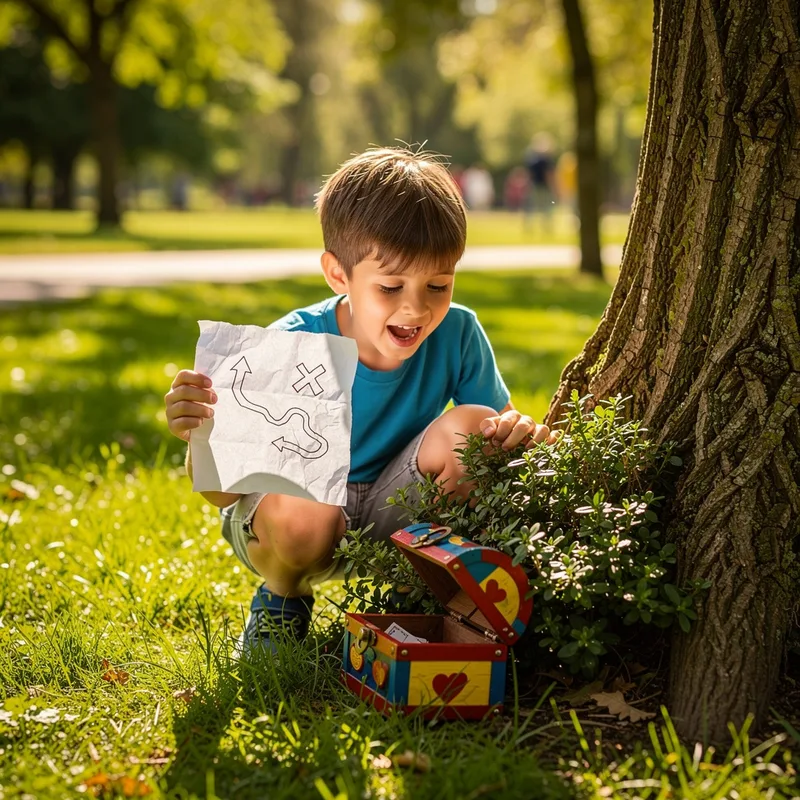
treasure hunt
 16
2.8
16
2.8

- noun
- /ˈtrɛʒər hʌnt/
 :
búsqueda del tesoro
:
búsqueda del tesoro
- The children had a great time during the treasure hunt, searching for hidden clues and prizes.
And then they go on a treasure hunt to find that solution.
- And then they go on a treasure hunt to find that solution.
- And this week I found myself in a really really cool treasure hunt.
- So I'm planning to do a birthday treasure hunt.
- Oh, my God, I can't even express you the treasure hunt that I went on for these boots.
Examples
-
There was to be a family night at the country club that evening, a kind of middle-of-the-summer event that began with games, a treasure hunt, and finished, after supper, with a display of fireworks.
Fiction book (1994) -
Just last weekend, we did a treasure hunt in our minority language for our children.
Blog text (7) -
And then they go on a treasure hunt to find that solution.
-
We have super secret treasure hunt, which is really fun.
-
We're going on a treasure hunt.
-
We'll have a treasure hunt.
-
My dad set up a treasure hunt.
Fiction book (1998) -
And so the treasure hunt begins.
-
We also love to go on treasure hunts outdoors and pick up interesting things from nature.
Blog text (19) -
Narrator: The pirates were a jolly crew the next morning when we set out on the treasure hunt.
Fiction book (1998)
How Exciting

Surface Forms
Morphology
The meaning 'a game in which players search for hidden objects or prizes' is directly and transparently derived from combining 'treasure' (valuable hidden items) with 'hunt' (a search). This compound noun follows a straightforward compositional pattern found in many languages, so a B1 learner who knows both constituents will readily infer the MWE meaning.
Etymology
Treasure hunt comes from the simple idea of treasure, hidden goods, and hunt, searching for them. Imagine following a map and clues to find a chest of gold like in pirate stories, and that is why a treasure hunt means 'a game in which players search for hidden objects or prizes'.