
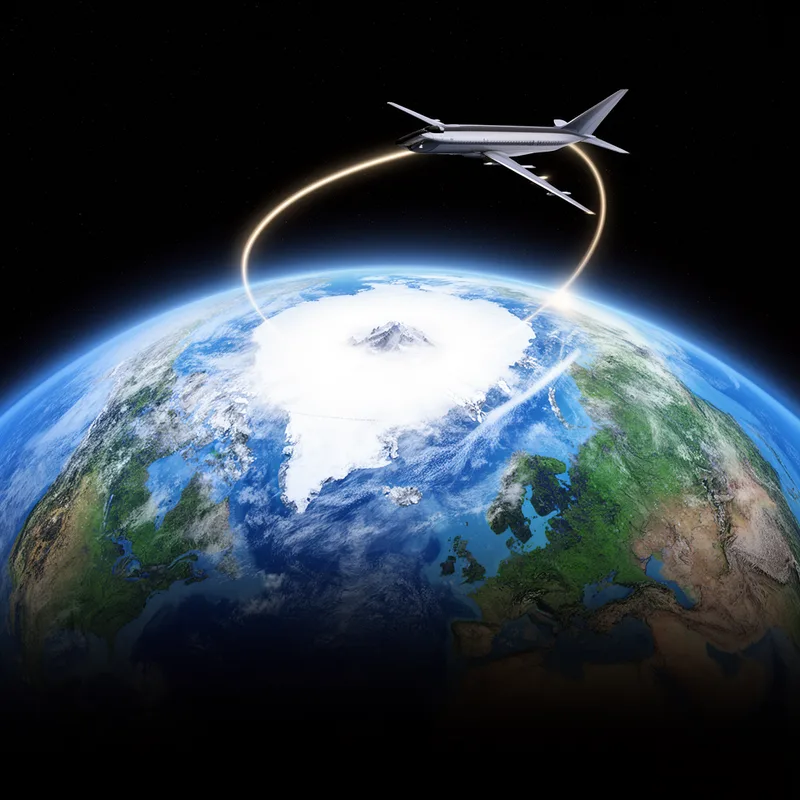
transpolar


 1
9.1
Going across one of the Earth's poles, like the North or South Pole
- adjective
- /trænzˈpoʊlər/
- Specialized
:
transpolar
- Until the advent of the Northeast Passage, otherwise known by its Russian name, the Northern Sea Route, the Northwest Passage, and the Transpolar Passage, Arctic sea routes were largely inaccessible due to the presence of thick ice.
Examples
-
Many airlines offer transpolar routes that allow for shorter travel times between continents.
-
Rigor and Wallace (2004) suggest that a prime influence in the decline in ice age thickness in the Arctic was a paradigm shift in the state of the Beaufort Gyre and the Transpolar Drift that occurred at the end of the Eighties.
Blog text (9) -
Scientists are studying the effects of climate change on transpolar ecosystems at the North Pole.
-
The transpolar shipping lanes provide a new route for trade between Europe and Asia.
Surface Forms
transpolar positive
Morphology
Etymology
Transpolar is made of trans- meaning 'across', as in transport, and polar from 'pole', the North or South end of the Earth. So transpolar means 'across the pole' or crossing one of the Earth's poles.