
transhumance
- noun
- /trænˈʃuːməns/
- Specialized
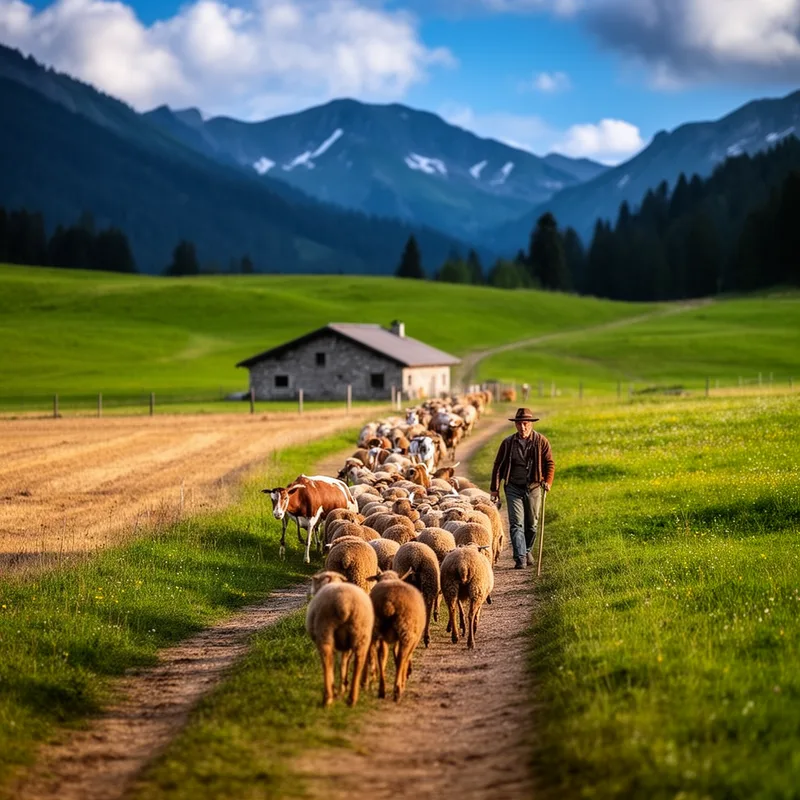
- Transhumance is the seasonal movement of livestock that follows the same routes every year.
- practicing transhumance
- sheep transhumance
- farms practicing transhumance
Examples
-
Under such circumstances—large flocks and purchase of feed—transhumance yields greater profits, for it is supported by a premium per transhumant sheep.
Academic text (2011) -
Farms practicing transhumance accounted for a large share of that increase.
Academic text (2011) -
We can assume that the figure will be higher for farms involved in transhumance, as the amount of subsidy is higher.
Academic text (2011) -
Some farmed a few months each year and resumed transhumance after the harvest.
Academic text (1992) -
Smaller farms commonly join larger ones when practicing transhumance, forming flocks of more than 1,000 sheep.
Academic text (2011) -
We demonstrate that the CAP has animated transhumance in many marginal portions of the Ebro Valley.
Academic text (2011) -
Around the mid-1900s, transhumance between the Pyrenees and the Ebro Valley underwent an almost terminal crisis.
Academic text (2011) -
The ancient practice of transhumance allowed farmers to utilize different pastures throughout the year.
-
During transhumance, shepherds lead their sheep to higher elevations in summer for better grazing.
-
Transhumance involves herding cattle from the lowlands to highlands seasonally for grazing.
Synonyms
 41
3.0
41
3.0

Regular movement of animals between regions to find food or breed

Regular movement of animals or people to different places when seasons change
Surface Forms
Morphology
transhumance = trans + hum + ance
Although 'trans-' (across) and the noun-forming '-ance' are recognisable, the central element 'hum' is not a productive standalone English morpheme and the specific specialised meaning ('seasonal movement of livestock') cannot be reliably derived by an average learner.
Etymology
Transhumance comes from the Latin parts trans- 'across' (as in transport) and humus 'ground', so it literally means moving 'across the land' and now refers to the regular, seasonal moving of animals between low and high grazing areas.