
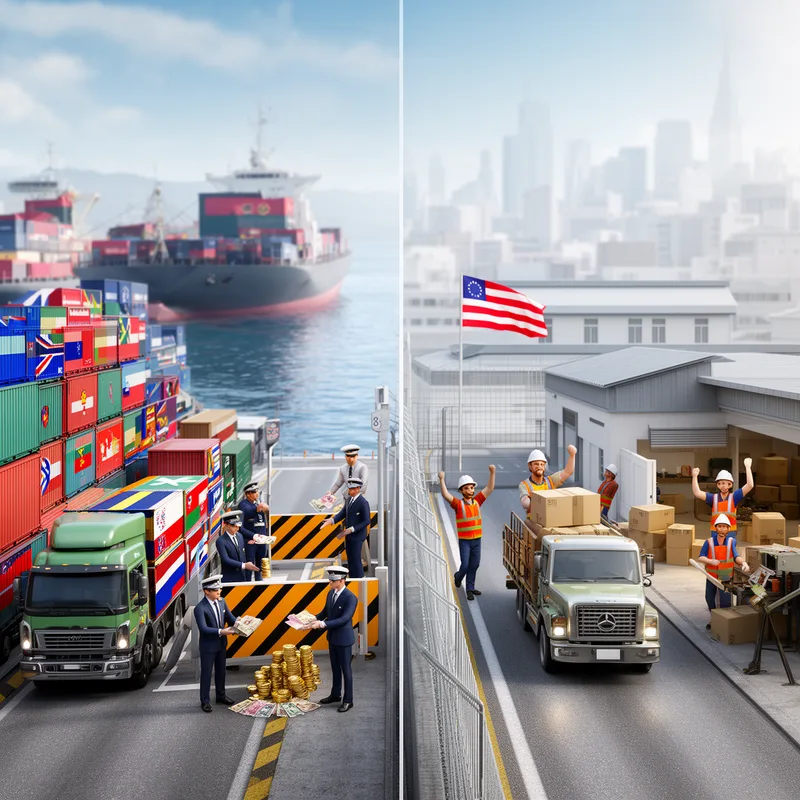
trade protection


 1
5.0
1
5.0
- noun
- /treɪd prəˈtɛkʃən/
- The government imposed trade protection measures to help local manufacturers compete against cheaper foreign imports.
Loading YouTube…
Watch on YouTubeMost economists agree that a world embroiled in various forms of trade protection is a world that is worse off.
- Most economists agree that a world embroiled in various forms of trade protection is a world that is worse off.
Examples
-
This outcome led to asymmetry in CANACINTRA's material relationship with the state in that its members came to depend on the state for trade protection, subsidies, and government purchases far more than the state depended on these smaller firms' contributions to economic activity.
Academic text (2000) -
This means holding down government spending, reducing its massive bureaucratic structures, and beginning to dismantle extensive trade protections.
Academic text (1996) -
Most economists agree that a world embroiled in various forms of trade protection is a world that is worse off.
-
Trade protection, in contrast, leads to a sustained misallocation of resources and a lower total output.
Academic text (1990) -
The chamber supported policies that generally benefited its members, such as trade protection and consumption subsidies that bolstered local demand.
Academic text (2000) -
The U.S. companies that are demanding trade protection from China or a revaluation of its currency are primarily small- and medium-sized firms that have not been able to access its market.
Academic text (2003) -
Whatever happens, appeals within the EC for public sector intervention and for trade protection will tax the patience of industrial and political leaders as unification proceeds.
Academic text (1992) -
But the reason the excerpt made me jump is the similarity it has to arguments that proponents of import substitution often make in support of trade protection.
Blog text (1) -
Current WTO language permits trade protection on the basis of product quality (for example, food products containing residues of a chemical banned in the importing country) but not on the process of production.
Academic text (2003) -
Here, politically sophisticated and well-organized farmers use their influence to demand commodity price supports, trade protection, and generous input subsidies—with damaging environmental results.
Academic text (1994)
Synonyms
 17
7.0
17
7.0
A government policy that helps local businesses by making foreign goods more expensive or limiting imports
 9
5.0
9
5.0
A government rule that limits goods from other countries, for example by charging extra tax or setting limits
 1
6.6
1
6.6
A tax on goods from other countries that makes them more expensive to help local businesses
 1
8.9
1
8.9
A policy of limiting people or goods entering a country

A rule or tax that limits goods coming into a country
Antonyms

How Protectionist

Surface Forms
Morphology
The meaning is a straightforward composition of 'trade' (commercial activity) and 'protection' (shielding or safeguarding), i.e. measures to protect trade—such as duties or quotas—to benefit domestic industry. This is a common, cross-linguistic economic collocation and a B1 learner who knows both constituent words can readily infer the MWE's meaning.
Etymology
The compound noun trade protection comes from the image of a country putting up a 'shield' around its own shops and factories to keep out cheaper foreign goods. The word trade means buying and selling between countries and protection means measures like taxes or limits, so the phrase means 'rules to protect local industries'.